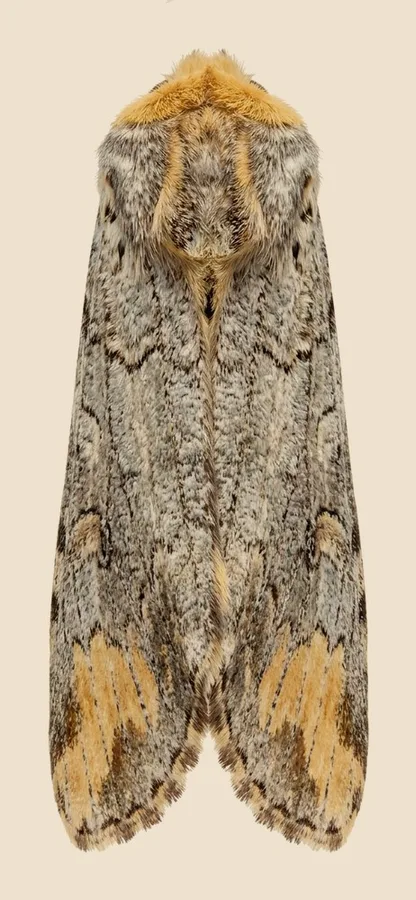
Buff-tip
At rest, this moth folds itself into a shape so close to a snapped silver birch twig that it can be nearly invisible against bark.
| Where | Mixed woodland and hedgerows |
|---|---|
| Size | 44 to 68 mm wingspan |
| When | May to September |
The adult holds its wings rolled around its body at rest, with pale buff patches at the wingtips and on the head that complete a convincing resemblance to a broken twig; the wingspan runs from about 44 to 68 mm.
Caterpillars are yellow and black with fine pale hairs, feed gregariously in groups on trees such as oak, birch, and lime, and can defoliate whole branches before descending into the soil in autumn to pupate and spend the winter underground.
Traits
Habitat
Woodland
Colour
Brown, Yellow, Black
Active
Night
To people
Harmless
Activity through the year
Often confused with
The pale prominent mimics a splinter of wood with a greyish-brown, elongated shape and long palps, lacking the buff-tip's pale buff patches at the wingtips and head.
Questions
Is the Buff-tip dangerous to people?
The Buff-tip is harmless to people.
When can you see the Buff-tip?
The Buff-tip can be seen from May to September, at night.
Plate retouched from a photo by gailhampshire from Cradley, Malvern, U.K, CC BY 2.0, Wikimedia Commons Licence
Report a mistake in this entry
Butterflies and moths›Prominent moths›Phalera
Last updated 2026-09-26. Every entry is checked against published sources.