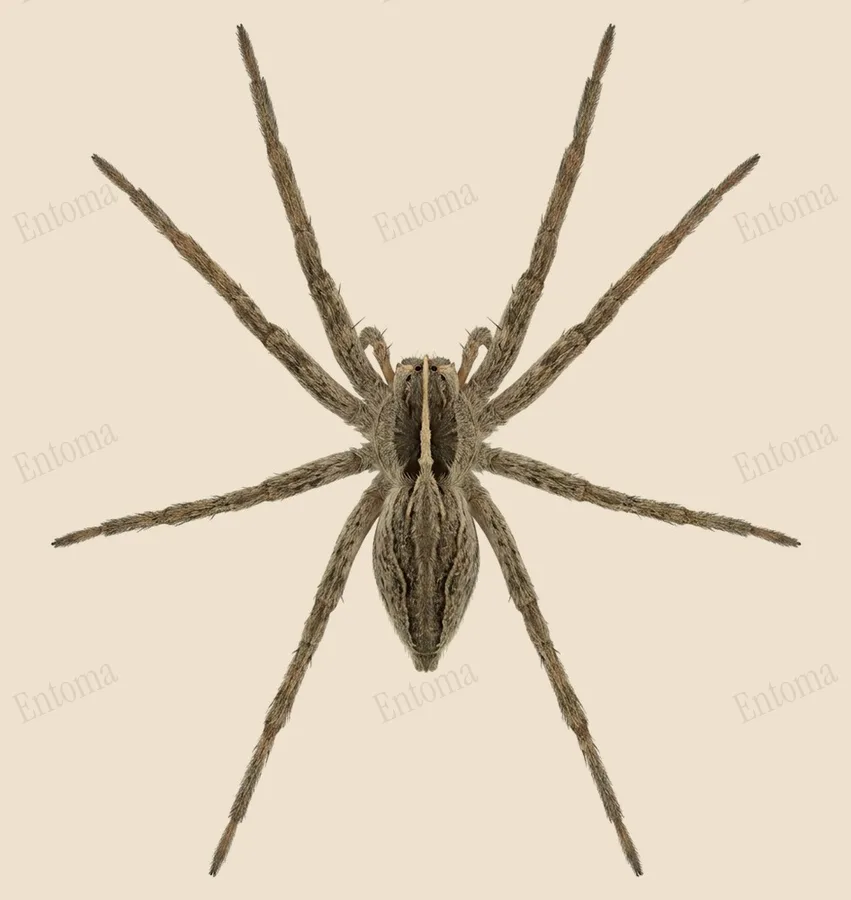
European nursery web spider
Before mating, the male offers the female an insect wrapped in silk, and will sometimes feign death to avoid being eaten while presenting this nuptial gift.
| Where | Damp grassland, heathland and woodland edges |
|---|---|
| Size | Male 10 to 13 mm, female 12 to 15 mm body length |
| When | February to October |
This slender, long legged spider is grey to reddish brown with a pale stripe running down the middle of the back, and is often mistaken for a wolf spider at first glance.
The female carries her egg sac gripped in her fangs rather than attached to her spinnerets, and just before the spiderlings hatch she spins a silk nursery tent around the sac in low vegetation and guards it closely until they disperse.
Traits
Habitat
Grassland
Colour
Brown, Grey
Active
Day
To people
This spider is not dangerous to people and does not build a web to trap prey; it is best known for the male's gift giving courtship and the female's silk nursery tent guarding her eggs.
Activity through the year
Often confused with
Easily confused with wolf spiders such as Pardosa amentata, but true wolf spiders carry a round egg sac attached to their spinnerets at the rear of the abdomen, while this species carries a flatter egg sac gripped in her fangs out in front of her body.
Questions
Is the European nursery web spider dangerous to people?
This spider is not dangerous to people and does not build a web to trap prey; it is best known for the male's gift giving courtship and the female's silk nursery tent guarding her eggs.
When can you see the European nursery web spider?
The European nursery web spider can be seen from February to October, by day.
Plate retouched from a photo by Andrew R., CC BY 4.0, iNaturalist Licence
Report a mistake in this entry
Spiders›Nursery web spiders›Pisaura
Last updated 2026-09-27. Every entry is checked against published sources.