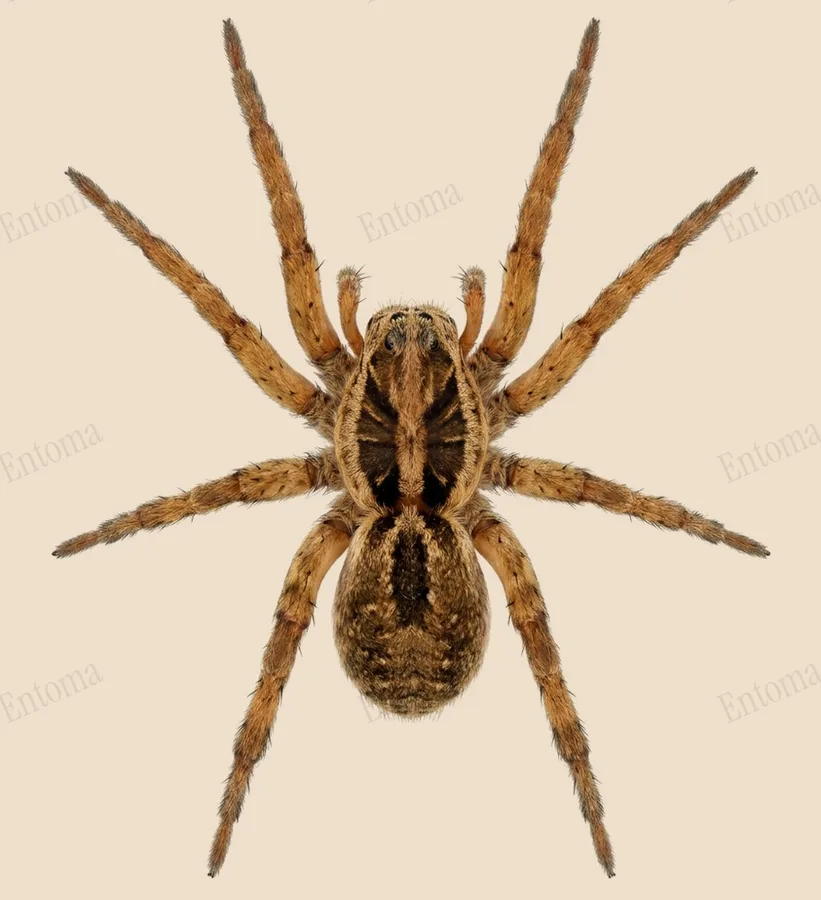
Radiated wolf spider
After mating in autumn, this wolf spider's female digs a shallow burrow and lets her spiderlings ride on her back through the winter.
| Where | Dry grassland and open woodland |
|---|---|
| Size | Female 12.5 to 25 mm, male 9 to 18 mm body length |
| When | April to October |
The Radiated wolf spider is a large, ground dwelling spider with a beige to brown body; radiating dark lines mark the face and carapace, and the legs carry darker bands toward the tips. Females are noticeably larger and darker than males, with dark brown to black undersides.
It hunts by day on dry grassland and in open woodland, chasing down insects on foot instead of spinning a web. Mating takes place in autumn, after which the female digs a shallow burrow to shelter her egg sac, and the spiderlings stay with her over winter before dispersing in spring.
Traits
Habitat
Grassland
Colour
Brown, Black
Active
Day
To people
Not dangerous to people; it hunts small insects on the ground and retreats into its burrow rather than approaching people.
Activity through the year
Often confused with
Digs a permanent, silk lined burrow topped with a small wall of stones and plant debris and rarely wanders far from it, unlike the Radiated wolf spider, which does not dig a burrow and wanders more widely over open ground.
Questions
Is the Radiated wolf spider dangerous to people?
Not dangerous to people; it hunts small insects on the ground and retreats into its burrow rather than approaching people.
When can you see the Radiated wolf spider?
The Radiated wolf spider can be seen from April to October, by day.
Plate retouched from a photo by katunchik, CC BY 4.0, iNaturalist Licence
Report a mistake in this entry
Last updated 2026-09-27. Every entry is checked against published sources.