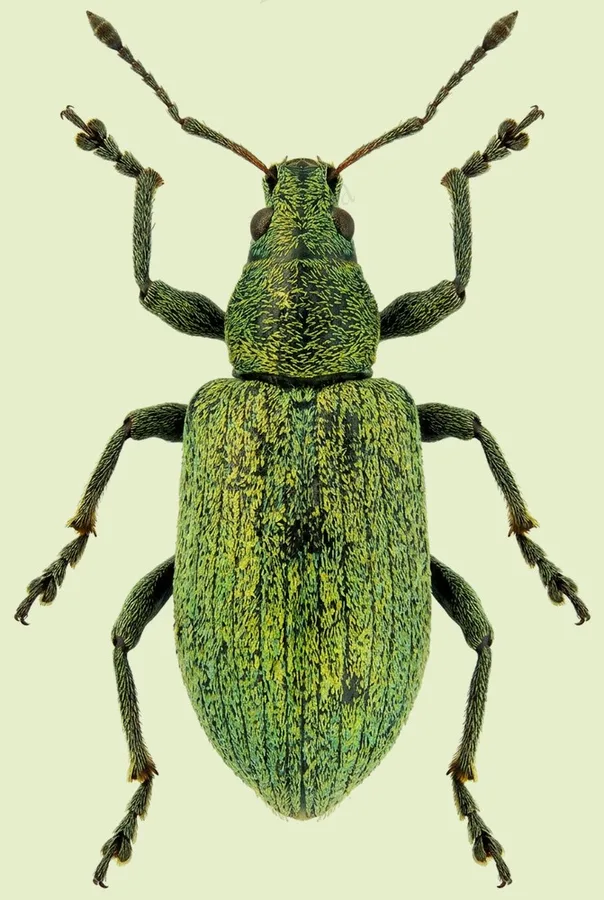
Nettle weevil
This beetle's elytra are covered in tiny metallic green scales that easily rub off with age, so older individuals can appear almost entirely black instead of green.
| Where | Nettle patches in grassland and hedgerows |
|---|---|
| Size | 7 to 9 mm body length |
| When | April to June |
Adults are slender weevils covered in tiny, pointed metallic green scales with gold, blue and copper tints, though the scales rub off with age to leave the black body beneath exposed. A small tooth on the front femur and a rostrum longer than it is wide help separate it from similar weevils.
Larvae develop in the soil feeding on the roots of stinging nettle, while adults climb the same plants to feed on leaves and stems above ground through late spring and early summer.
Traits
Habitat
Grassland
Colour
Green, Metallic
Active
Day
To people
Feeds only on nettle leaves and does not bite or sting people.
Activity through the year
Often confused with
Similar size at about 7.5 to 12 mm body length, but with pale reddish brown femora rather than the darker legs of the Nettle weevil.
Questions
Is the Nettle weevil dangerous to people?
Feeds only on nettle leaves and does not bite or sting people.
When can you see the Nettle weevil?
The Nettle weevil can be seen from April to June, by day.
Plate retouched from a museum specimen photo by Uno Roosileht, Estonian Museum of Natural History, CC BY 4.0, GBIF Licence
Report a mistake in this entry
Last updated 2026-09-26. Every entry is checked against published sources.