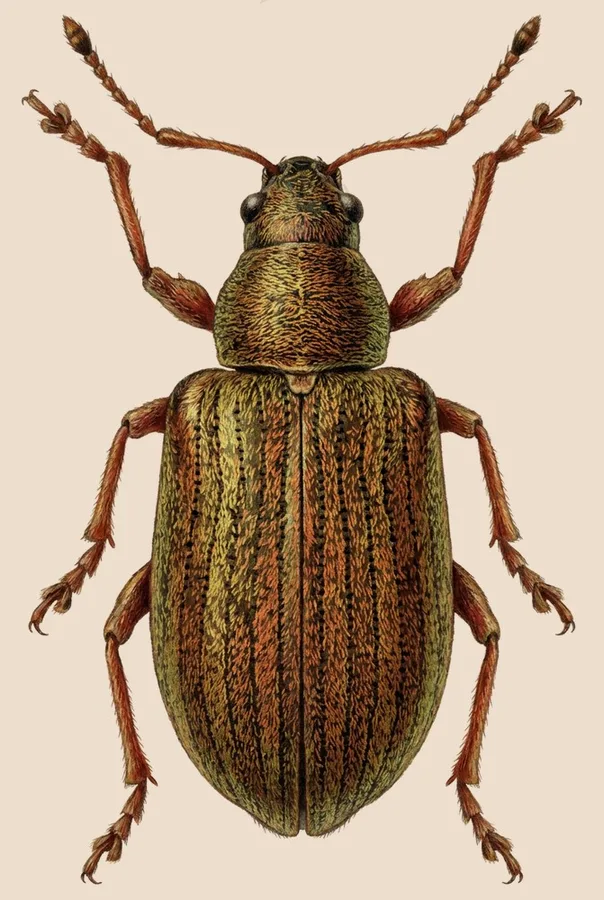
Common leaf weevil
This tiny weevil often drops from a leaf and plays dead when disturbed, a trick that can fool birds and other predators into losing interest.
| Where | Trees and shrubs in gardens |
|---|---|
| Size | 5 to 7 mm body length |
| When | April to June |
The common leaf weevil is a small, oval beetle with a short curved snout and elbowed antennae. Its wing cases are coppery when freshly emerged, darkening with age, and its reddish brown legs carry a distinct tooth along with fine ridges not found in most related species.
Adults feed on the leaves of trees and shrubs in spring and early summer, chewing small notches from the edges of leaves. When disturbed, they often drop from the foliage and remain motionless, a defense known as feigning death.
Traits
Habitat
Garden
Colour
Brown, Metallic
Active
Day
To people
Common on garden shrubs in spring; harmless to handle and not a pest of concern indoors.
Activity through the year
Often confused with
Smaller at about 4 to 6 mm, with a more uniform bright golden green coat of scales and legs that lack the reddish colour and leg tooth of the common leaf weevil.
Questions
Is the Common leaf weevil dangerous to people?
Common on garden shrubs in spring; harmless to handle and not a pest of concern indoors.
When can you see the Common leaf weevil?
The Common leaf weevil can be seen from April to June, by day.
Plate retouched from a photo by Udo Schmidt from Deutschland, CC BY‑SA 2.0, Wikimedia Commons Licence
The plate on this page is shared under the same licence as its source, CC BY-SA.
Report a mistake in this entry
Last updated 2026-09-26. Every entry is checked against published sources.