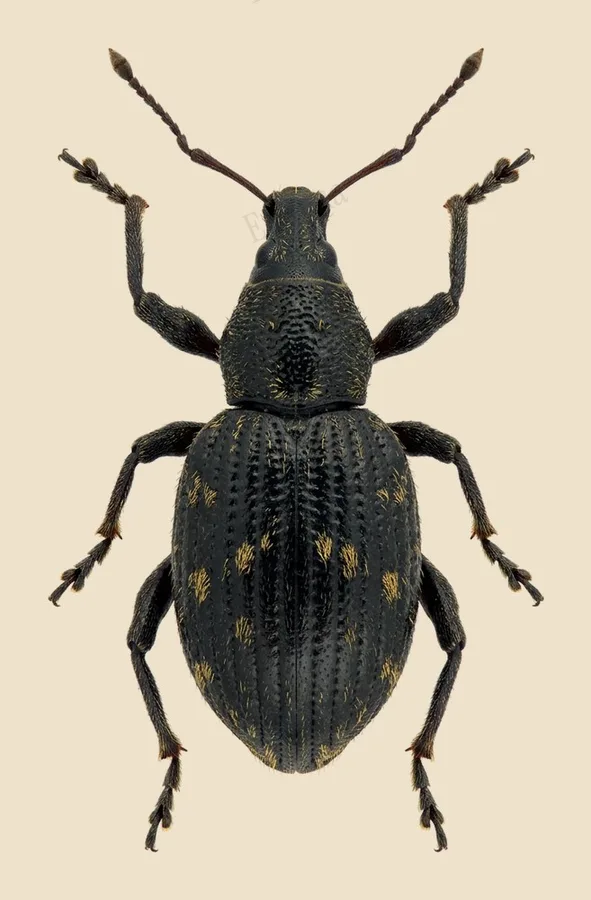
Black vine weevil
Every adult is female, and each one can lay several hundred eggs without ever mating, producing offspring that are exact copies of herself.
| Where | Gardens, parks, and nurseries |
|---|---|
| Size | 9 to 13 mm long |
| When | March to October |
This weevil is dark, almost black, with a long snout, elbowed antennae, and small patches of golden brown scales on its fused, flightless wing cases. Adults measure roughly 9 to 13 mm long.
Active mainly at night, it notches the edges of leaves while feeding, and every adult is female, laying up to 500 eggs near host plants without needing to mate.
Traits
Habitat
Garden
Colour
Black, Brown
Active
Night
To people
Harmless to people; a nuisance only to plants.
Activity through the year
Often confused with
The clay-coloured weevil is smaller at about 8 mm long and has a scaly, clay brown body, compared with the black vine weevil's larger, darker, more sparsely scaled form.
Questions
Is the Black vine weevil dangerous to people?
Harmless to people; a nuisance only to plants.
When can you see the Black vine weevil?
The Black vine weevil can be seen from March to October, at night.
Plate retouched from a photo by Don Loarie, CC BY 4.0, Wikimedia Commons Licence
Report a mistake in this entry
Last updated 2026-09-26. Every entry is checked against published sources.