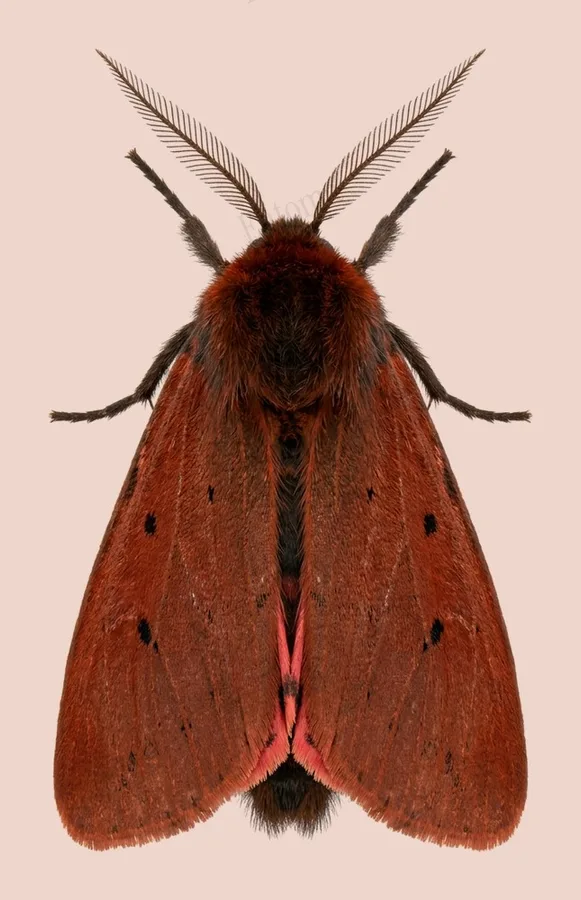
Ruby tiger moth
The ruby tiger moth grows steadily darker toward the north of its range, with a separate subspecies replacing the brighter southern form.
| Where | Grassland, gardens, and waste ground |
|---|---|
| Size | 30 to 35 mm wingspan |
| When | May to October |
It is a hairy-bodied moth with dull reddish-brown forewings and a red abdomen banded with black spots; the hindwings are pale pink with dark shading along the margins, and the wingspan runs from about 30 to 35 mm.
Caterpillars are polyphagous, feeding on a wide range of herbaceous plants such as dock and plantain, and the second brood overwinters as a nearly full-grown larva that can be seen wandering or basking on low vegetation before it pupates in spring.
Traits
Habitat
Grassland
Colour
Red, Brown
Active
Night
To people
Harmless
Activity through the year
Often confused with
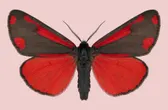
The cinnabar has slate-black forewings with two red spots and pink-red streaks, quite different from the ruby tiger's uniform reddish-brown forewings and pale pink hindwings.
Questions
Is the Ruby tiger moth dangerous to people?
The Ruby tiger moth is harmless to people.
When can you see the Ruby tiger moth?
The Ruby tiger moth can be seen from May to October, at night.
Plate retouched from a photo by Ben Sale from UK, CC BY 2.0, Wikimedia Commons Licence
Report a mistake in this entry
Butterflies and moths›Erebid moths›Phragmatobia
Last updated 2026-09-26. Every entry is checked against published sources.