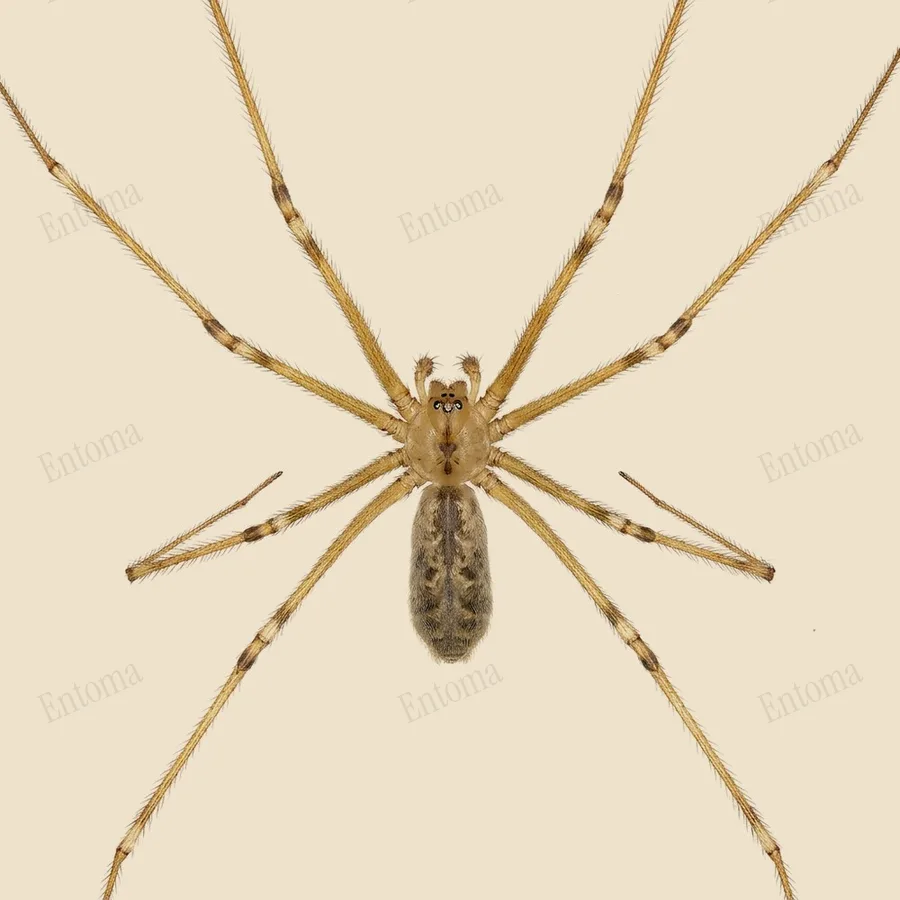
Long-bodied cellar spider
A popular myth claims this spider's venom is the deadliest of any species, but in truth it is not known to bite people and poses no danger.
| Where | Cellars, caves and dark building corners |
|---|---|
| Size | Male 6 to 10 mm, female 7 to 8 mm body length |
| When | January to December |
This pale grey brown spider has an extremely slender body only about 6 to 10 mm long, carried on legs many times that length, and hangs upside down in a loose, irregular web in dark corners of buildings, cellars and caves.
When disturbed it bounces rapidly in its web, blurring its outline to confuse predators, a defence it relies on far more than any bite. It breeds through the year indoors, with a female producing several small egg sacs that she carries in her jaws until they hatch.
Traits
Habitat
Towns
Colour
Grey, Brown
Active
Day and night
To people
This spider is not known to bite people and poses no danger; the popular claim that it carries extremely potent venom but cannot bite through skin is a myth with no scientific support.
Activity through the year
Often confused with
Distinctly smaller at 3 to 5 mm body length against 6 to 10 mm for the long bodied cellar spider, with an irregular dark stripe down a light brown carapace rather than the single large grey patch of the long bodied cellar spider.
Questions
Is the Long-bodied cellar spider dangerous to people?
This spider is not known to bite people and poses no danger; the popular claim that it carries extremely potent venom but cannot bite through skin is a myth with no scientific support.
When can you see the Long-bodied cellar spider?
The Long-bodied cellar spider can be seen from January to December, by day and at night.
Plate retouched from a photo by Christian Back, CC BY 4.0, iNaturalist Licence
Report a mistake in this entry
Spiders›Cellar spiders›Pholcus
Last updated 2026-09-27. Every entry is checked against published sources.