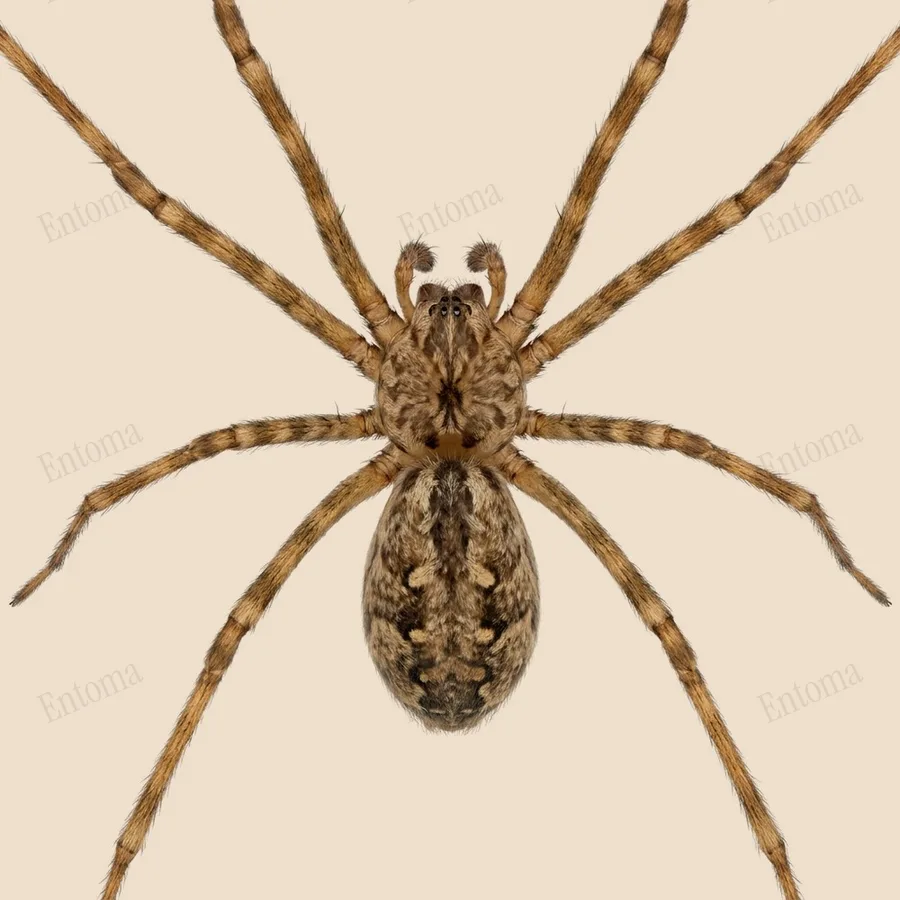
Marbled cellar spider
Many never build their own web; most move into an existing one and often switch to new shared webs several times in a lifetime.
| Where | Buildings, walls and Mediterranean rock crevices |
|---|---|
| Size | 5 to 7.5 mm body length, both sexes similar |
| When | April to November |
The marbled cellar spider has a slender, pale body with a dark, irregular stripe running down the back and long, fragile legs ringed in black and white at each joint. Both sexes reach about 5 to 7.5 mm in body length, with males and females close to the same size.
It builds loose, tangled webs under stones, in cellars and along the eaves and ceilings of buildings across warm, dry parts of the Mediterranean, and it has since spread with people into greenhouses and garden centres further north. Rather than living alone, many individuals share a web and move between webs repeatedly over their lives.
Traits
Habitat
Towns
Colour
Brown, Grey, White
Active
Day and night
To people
Not known to bite people; it hangs in loose webs in cellars, sheds and outbuildings and is easily left undisturbed.
Activity through the year
Often confused with
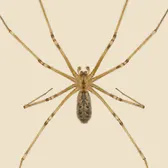
The long-bodied cellar spider is larger and more uniformly pale grey, at about 7 to 10 mm with plain, unbanded legs, while the marbled cellar spider is smaller and shows sharp black and white rings at each leg joint.
Questions
Is the Marbled cellar spider dangerous to people?
Not known to bite people; it hangs in loose webs in cellars, sheds and outbuildings and is easily left undisturbed.
When can you see the Marbled cellar spider?
The Marbled cellar spider can be seen from April to November, by day and at night.
Plate retouched from a museum specimen photo by Staatliche Naturwissenschaftliche Sammlungen Bayerns, CC BY 4.0, GBIF Licence
Report a mistake in this entry
Spiders›Cellar spiders›Holocnemus
Last updated 2026-09-27. Every entry is checked against published sources.