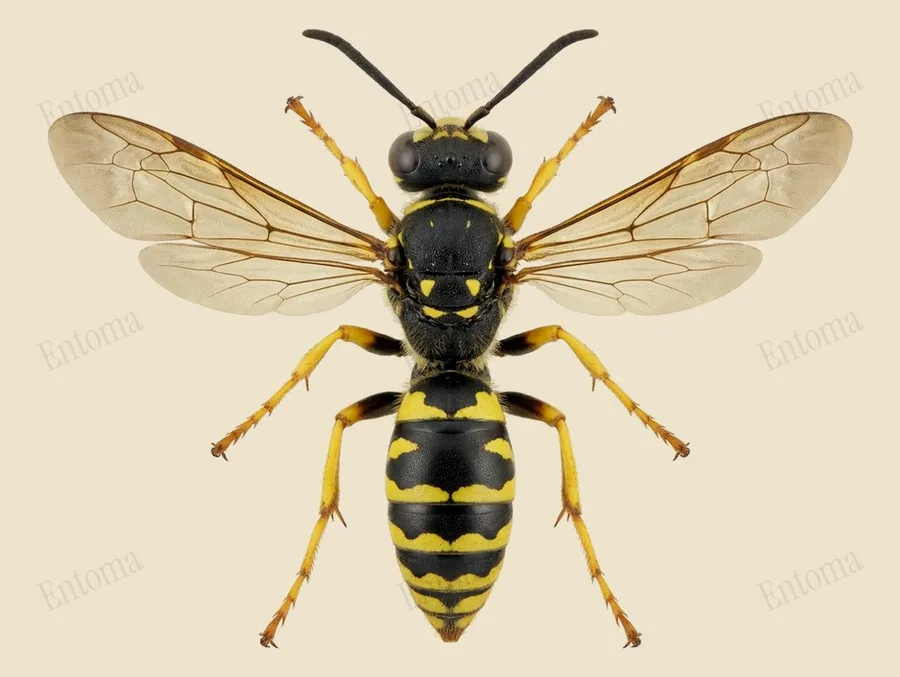
European beewolf
A female European beewolf embalms each paralyzed honeybee with gland secretions before sealing it underground as food for a single larva.
| Where | Sandy dunes, heaths and sand pits |
|---|---|
| Size | 8 to 17 mm body length |
| When | June to September |
It is a large, robust digger wasp with bold yellow and black banding, a reddish tinge on the head behind the eyes, and thickened antennae, and males show a trident shaped yellow mark on the face.
Females sting and paralyze honeybees, carry them back to a sandy burrow, and pack several bees into a sealed underground chamber to feed a single developing larva.
Traits
Habitat
Heath
Colour
Yellow, Black
Active
Day
To people
Mild
Females can sting if handled, but it hunts honeybees and is not aggressive toward people.
Activity through the year
Often confused with
It hunts small solitary bees rather than honeybees and the males lack the beewolf's trident shaped facial marking.
Questions
Is the European beewolf dangerous to people?
Mild. Females can sting if handled, but it hunts honeybees and is not aggressive toward people.
When can you see the European beewolf?
The European beewolf can be seen from June to September, by day.
Plate retouched from a photo by A szu, CC BY‑SA 4.0, Wikimedia Commons Licence
The plate on this page is shared under the same licence as its source, CC BY-SA.
Report a mistake in this entry
Bees, wasps and ants›Crabronid wasps›Philanthus
Last updated 2026-09-26. Every entry is checked against published sources.