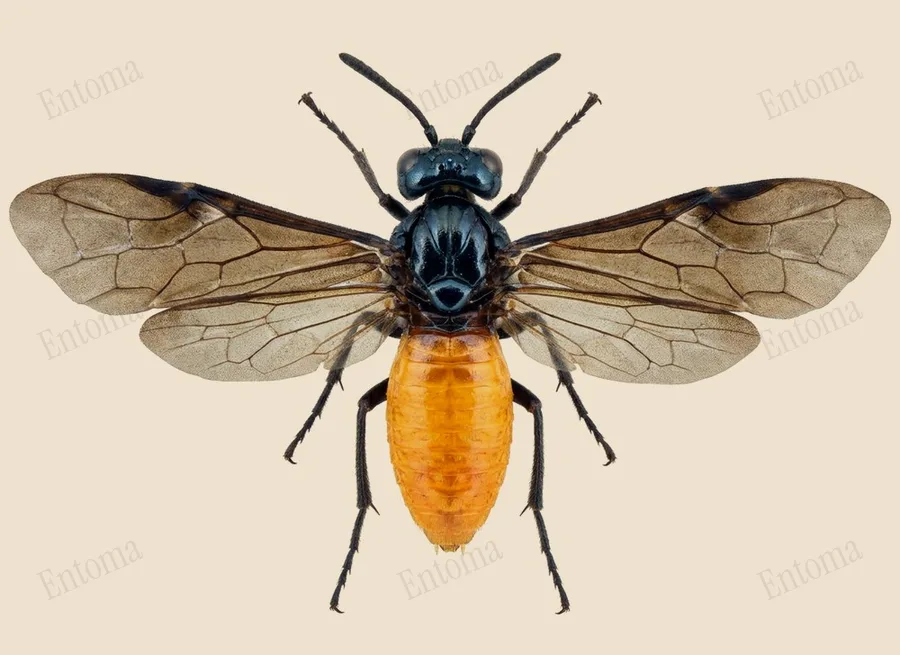
Large rose sawfly
Larvae hatch from eggs laid in a double row of slits along a rose stem, a pattern that separates this sawfly from its near identical look-alike.
| Where | Gardens and hedgerows with roses |
|---|---|
| Size | 8 to 10 mm body length |
| When | May to September |
Adults have a bright yellow abdomen contrasting with black legs, thorax, and head, and the antennae look like a single long fused segment rather than the branched or feathered antennae of many other sawflies. The wings often show a faint blue metallic sheen.
Females cut a row of slits into rose stems to lay their eggs, and the pale green larvae with black spots that hatch from them feed together in groups on the leaves. Two or sometimes three generations can occur between spring and autumn.
Traits
Habitat
Garden
Colour
Black, Yellow
Active
Day
To people
Larvae feed in groups on rose leaves and can defoliate stems, but adults do not sting or bite people.
Activity through the year
Often confused with
Nearly identical in size and coloring, but told apart by the egg laying scars on rose stems: a single row of slits for Arge ochropus against a double row for the Large rose sawfly.
Questions
Is the Large rose sawfly dangerous to people?
Larvae feed in groups on rose leaves and can defoliate stems, but adults do not sting or bite people.
When can you see the Large rose sawfly?
The Large rose sawfly can be seen from May to September, by day.
Plate retouched from a museum specimen photo by Joseph Monks, Natural History Museum, CC0, GBIF Licence
Report a mistake in this entry
Bees, wasps and ants›Argid sawflies›Arge
Last updated 2026-09-26. Every entry is checked against published sources.