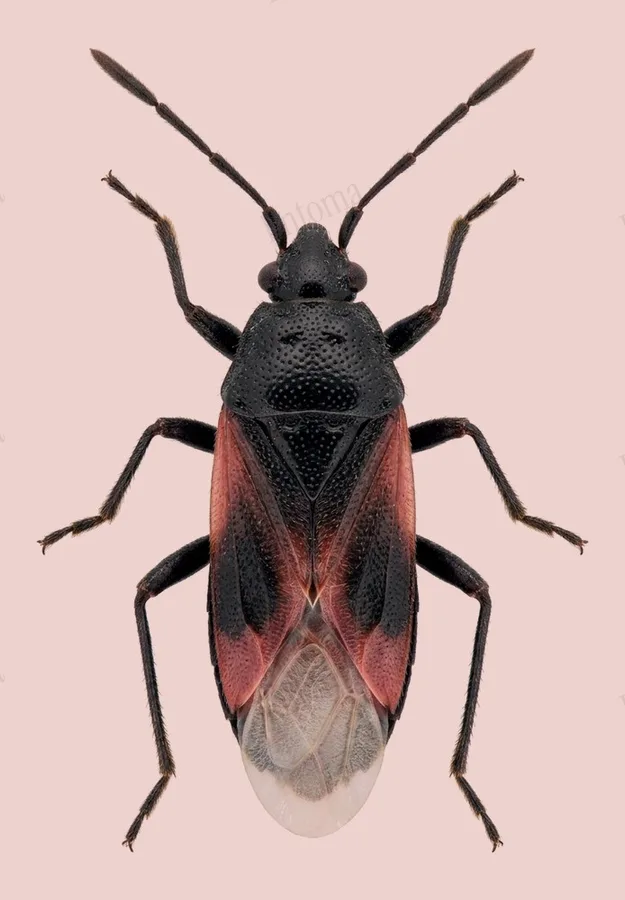
Lime seed bug
Overwintering swarms of this small bug can coat entire lime tree trunks in a moving blanket of thousands of individuals.
| Where | Lime trees and mallow shrubs in parks |
|---|---|
| Size | 4.2 to 5.4 mm body length |
| When | All year |
This is a small, narrow ground bug with a black head, black prothorax and black antennae set against a brick red upper abdomen, while nymphs show a similar black head and red body. The pattern of black, white and red areas on the wings makes it easy to tell from other small seed bugs found on the same trees.
Adults and nymphs feed on the seeds and sap of mallow family plants such as lavatera, hibiscus and hollyhock, but the species overwinters in dense aggregations on the bark of lime trees, tolerating light frosts before dispersing again in spring.
Traits
Habitat
Towns
Colour
Red, Black, White
Active
Day
To people
Harmless to people; it does not bite or sting, though its large overwintering swarms on tree trunks and walls can be an unwelcome nuisance simply because of their numbers.
Activity through the year
Often confused with
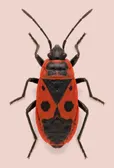
Noticeably larger at 8.5 to 12 mm, with a bolder red and black pattern including two round black spots and a black cross shape on the wings, rather than the lime seed bug's finer red, black and white banding.
Questions
Is the Lime seed bug dangerous to people?
Harmless to people; it does not bite or sting, though its large overwintering swarms on tree trunks and walls can be an unwelcome nuisance simply because of their numbers.
When can you see the Lime seed bug?
The Lime seed bug can be seen all year, by day.
Plate retouched from a photo by Gower, CC BY‑SA 4.0, Wikimedia Commons Licence
The plate on this page is shared under the same licence as its source, CC BY-SA.
Report a mistake in this entry
True bugs›Oxycarenidae›Oxycarenus
Last updated 2026-09-26. Every entry is checked against published sources.