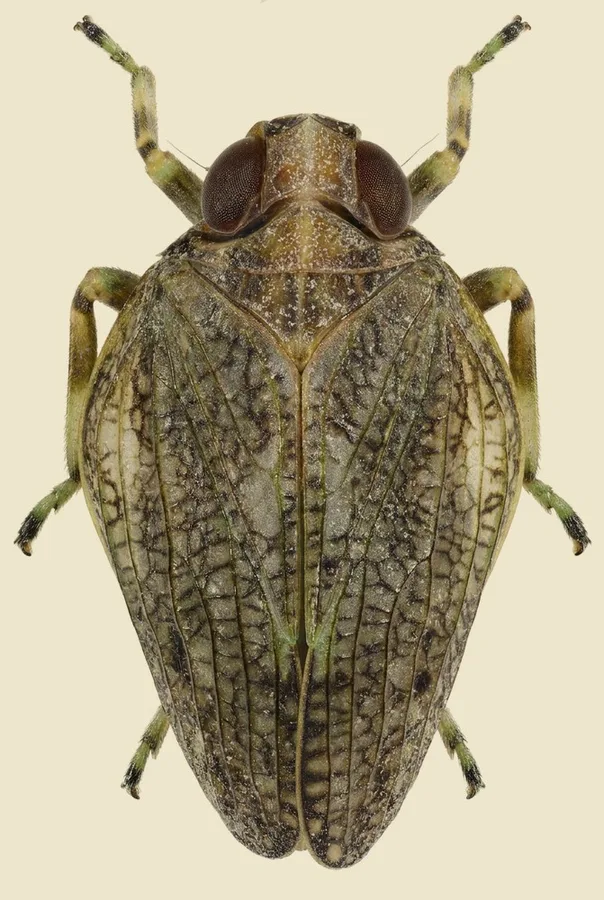
Issus coleoptratus
Its nymphs run on a working mechanical gear at the hip of each hind leg, the only true gear ever found in a living animal, then shed it at the final molt.
| Where | Ivy and shrubs in gardens and hedgerows |
|---|---|
| Size | 5.5 to 7 mm body length |
| When | May to October |
This flightless planthopper has a rounded, beetle-like body in shades of grey to brown, with forewings crossed by an unusually dense net of veins and a dark patch below the crown of the head. Nymphs are pale and carry tufts of waxy white filaments at the tip of the abdomen.
Nymphs and adults feed by piercing the phloem of ivy and deciduous trees such as lime, oak, maple and hazel, with young stages commonly overwintering on evergreen ivy before completing a single generation each year.
Traits
Habitat
Garden
Colour
Brown, Grey
Active
Day
To people
Harmless to people; it cannot fly or bite and simply hops away from disturbance.
Activity through the year
Often confused with
A much rarer and similarly sized planthopper best told apart by a pale yellow bar across the lower face, where Issus coleoptratus shows a uniformly dark area beneath the crown of the head.
Questions
Is Issus coleoptratus dangerous to people?
Harmless to people; it cannot fly or bite and simply hops away from disturbance.
When can you see Issus coleoptratus?
Issus coleoptratus can be seen from May to October, by day.
Plate retouched from a photo by janetgraham84new, CC BY 2.0, Wikimedia Commons Licence
Report a mistake in this entry
Last updated 2026-09-26. Every entry is checked against published sources.