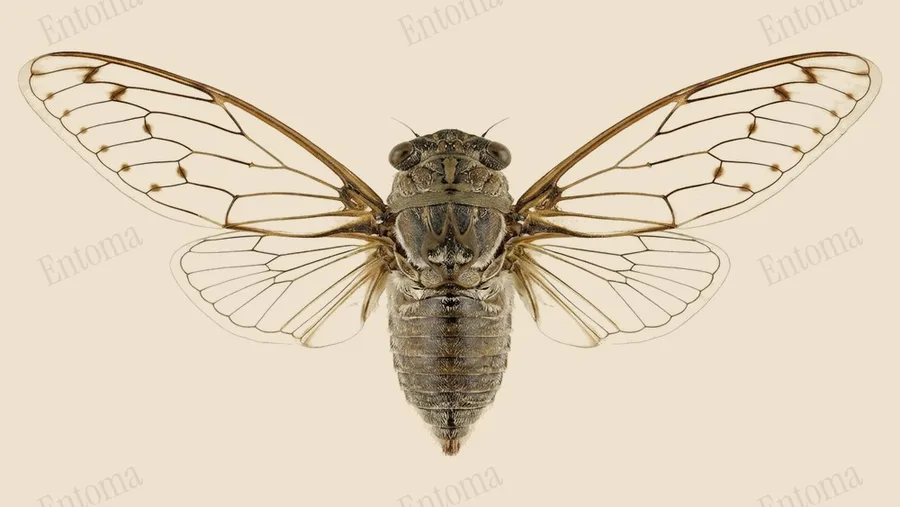
Ash cicada
Only male Ash cicadas sing, using ribbed plates on the abdomen that click over one hundred decibels to call females from the same sunlit branch.
| Where | Sunny broadleaf trees and orchards |
|---|---|
| Size | 23 to 28 mm body length |
| When | June to August |
The Ash cicada is a large, sap-feeding insect about 23 to 28 mm long, with a body that ranges from grey to brown, reddish abdominal segments, and transparent forewings marked with scattered black spots.
Only males sing, using a pair of ribbed membranes on the abdomen that click rapidly to produce a loud, sustained call from sunny branches, mainly of ash and other broadleaf trees. Eggs are laid in bark in summer, and the nymphs then live underground on root sap for several years before emerging as adults.
Traits
Habitat
Woodland
Colour
Brown, Grey
Active
Day
To people
Harmless to people; it feeds only on plant sap and does not bite or sting.
Activity through the year
Often confused with
Noticeably larger at 30 to 37 mm, one of the biggest European cicadas, compared with the smaller, more evenly marked Ash cicada.
Questions
Is the Ash cicada dangerous to people?
Harmless to people; it feeds only on plant sap and does not bite or sting.
When can you see the Ash cicada?
The Ash cicada can be seen from June to August, by day.
Plate retouched from a museum specimen photo by Fauvre Laurent, MNHN - Museum national d'Histoire naturelle, CC BY 4.0, GBIF Licence
Report a mistake in this entry
Last updated 2026-09-26. Every entry is checked against published sources.