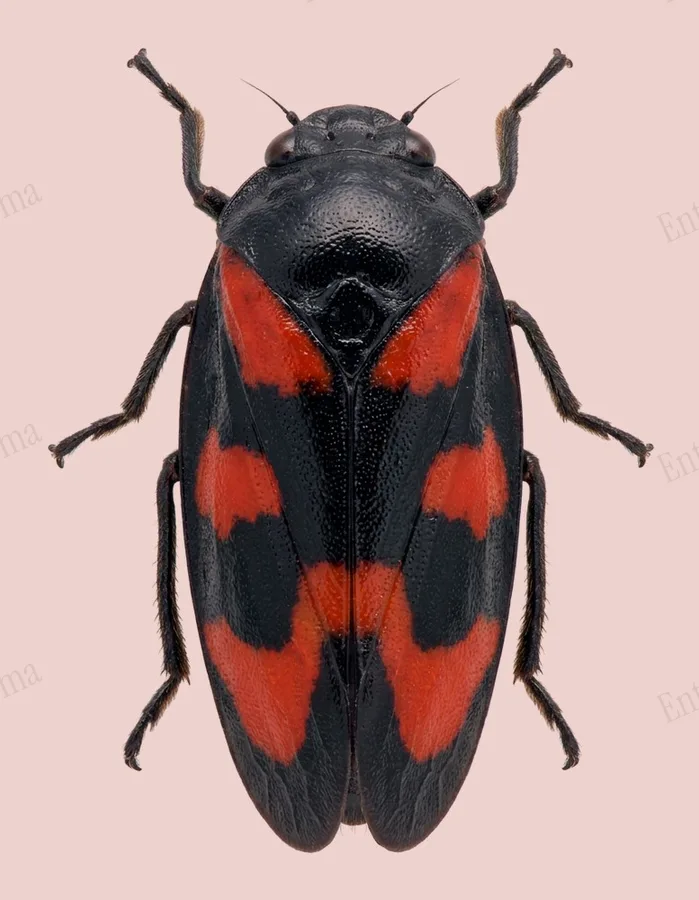
Common froghopper
Unlike most froghoppers, whose foamy young cling to stems in plain sight, this species spends its early life hidden underground on plant roots before ever showing its red and black colours.
| Where | Grassland, hedgerows, woodland edges, parks |
|---|---|
| Size | 8 to 10 mm long |
| When | April to August |
It has a glossy black body broken up by bold red patches: a triangular mark near the base of each wing case, a squarish patch in the middle, and a curved band near the tip, over a compact, shield-shaped body.
Nymphs develop underground on plant roots inside a protective foam nest that stops them drying out, overwintering there and only surfacing as winged red and black adults the following spring.
Traits
Habitat
Grassland
Colour
Red, Black
Active
Day
To people
Harmless; feeds only on plant sap and does not bite or sting
Activity through the year
Often confused with
The blood-red froghopper has black legs just like the common froghopper, but its red markings are smaller and its rear red band is only slightly curved rather than forming the common froghopper's U shape.
Questions
Is the Common froghopper dangerous to people?
Harmless; feeds only on plant sap and does not bite or sting.
When can you see the Common froghopper?
The Common froghopper can be seen from April to August, by day.
Plate retouched from a photo by Patrick Hacker, CC BY 4.0, iNaturalist Licence
Report a mistake in this entry
True bugs›Froghoppers›Cercopis
Last updated 2026-09-26. Every entry is checked against published sources.