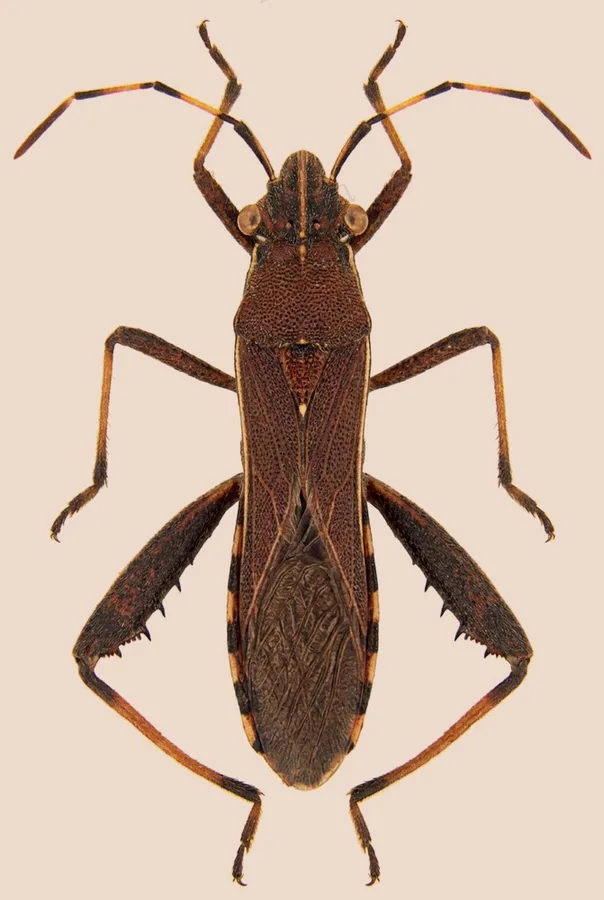
Broad-headed bug
This bug's head is broader than its own pronotum, and its hind legs are armed with thorn-like spines used to grip host plants such as broom and gorse.
| Where | Dry grassland and scrub with legumes |
|---|---|
| Size | 12 to 15 mm body length |
| When | April to October |
The broad-headed bug is an elongated, hairy insect 12 to 15 mm long, with a dark brown body, whitish margins and an orange-brown abdomen visible at the sides. Its head is wider than the pronotum, and the thickened, spiny hind femora and distinctly curved hind tibiae set it apart from similar species.
Adults and nymphs feed on the seed pods of legumes such as broom, gorse, clover and vetch, sucking sap from the developing seeds. It is active from April to October across dry grassy and scrubby places throughout much of Europe.
Traits
Habitat
Grassland
Colour
Brown, Orange
Active
Day
To people
It does not bite or sting people and is harmless to handle.
Activity through the year
Often confused with
Slightly smaller at 10 to 12 mm, with straight hind tibiae rather than the distinctly curved tibiae of Camptopus lateralis.
Questions
Is the Broad-headed bug dangerous to people?
It does not bite or sting people and is harmless to handle.
When can you see the Broad-headed bug?
The Broad-headed bug can be seen from April to October, by day.
Plate retouched from a photo by Michael J. Raupach , Lars Hendrich , Stefan M. Küchler, Fabian Deister, CC BY 4.0, Wikimedia Commons Licence
Report a mistake in this entry
True bugs›Broad-headed bugs›Camptopus
Last updated 2026-09-26. Every entry is checked against published sources.