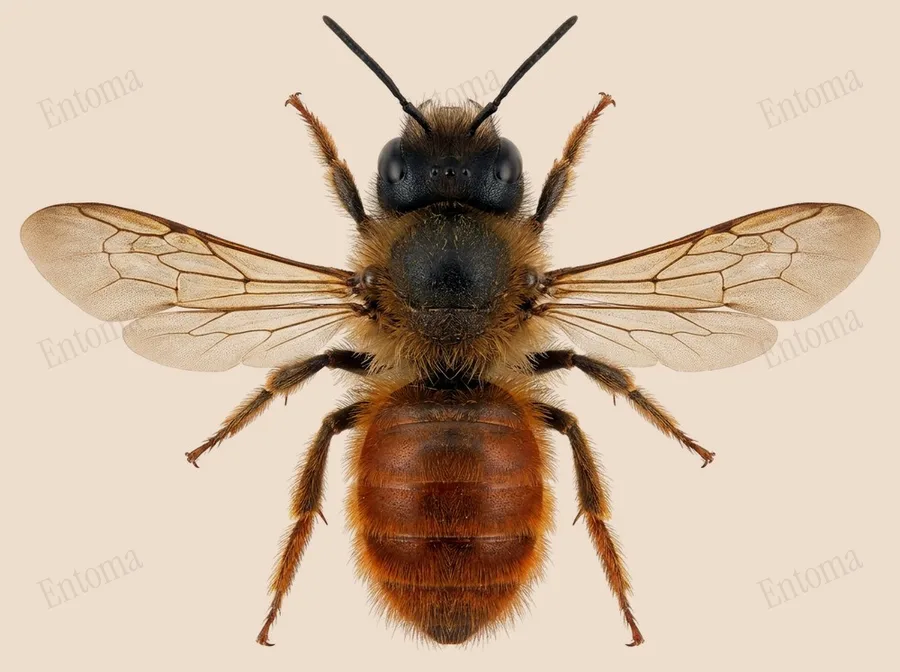
Red mason bee
Females carry two small horn-like points on their face, used to pack mud into place while sealing off each egg chamber in the nest.
| Where | Gardens, orchards, woodland edges |
|---|---|
| Size | 8 to 13 mm long |
| When | March to June |
This solitary bee has a bushy, orange-red abdomen and grey-brown hair on the thorax, and the female's face bears two small forward-curving horns beneath the antennae that give the species its name.
Rather than digging her own tunnel, the female occupies existing cavities such as hollow stems, beetle holes in dead wood or the tubes of a bee hotel, filling each one with a pollen loaf, an egg, and a mud partition before sealing the tube.
Traits
Habitat
Garden
Colour
Orange, Brown, Grey
Active
Day
To people
Mild
Not aggressive; females can sting weakly if trapped
Activity through the year
Often confused with
The European orchard bee is similarly horned but has black hair on the head and thorax, rather than the red mason bee's grey-brown thorax hair.
Questions
Is the Red mason bee dangerous to people?
Mild. Not aggressive; females can sting weakly if trapped.
When can you see the Red mason bee?
The Red mason bee can be seen from March to June, by day.
Plate retouched from a photo by NobbiP, CC BY‑SA 3.0, Wikimedia Commons Licence
The plate on this page is shared under the same licence as its source, CC BY-SA.
Report a mistake in this entry
Bees, wasps and ants›Leafcutter bees›Osmia
Last updated 2026-09-26. Every entry is checked against published sources.