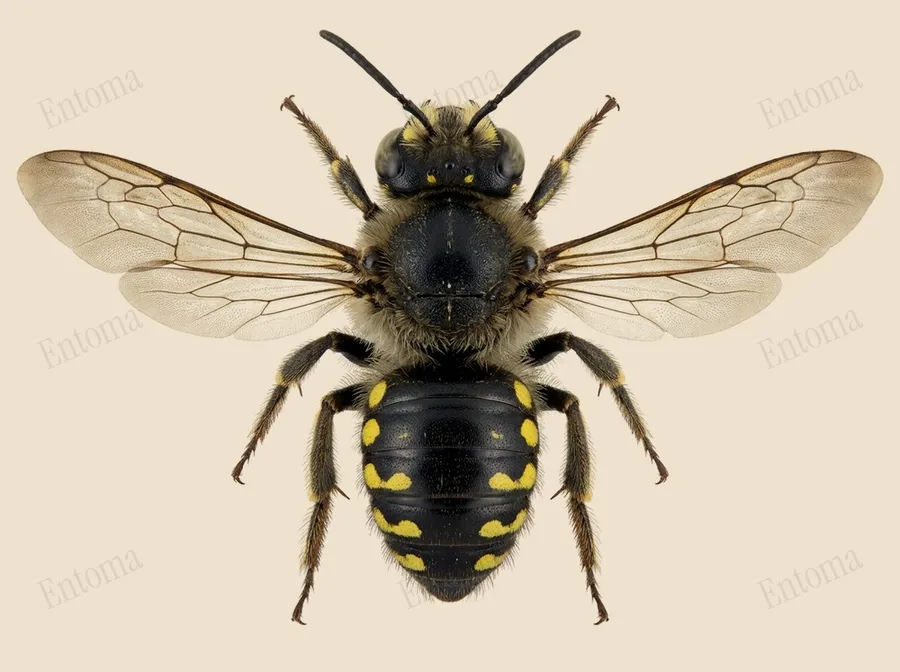
European woolcarder bee
Male European woolcarder bees carry no stinger at all, yet still ram rival insects with sharp abdominal spines to guard their flower patch.
| Where | Flower-rich gardens, fields and meadows |
|---|---|
| Size | 11 to 17 mm body length |
| When | May to August |
It is a stocky, mostly black bee with bold yellow spotting along the sides of the abdomen and yellow legs, and unusually for a solitary bee the males are noticeably larger than the females.
Males patrol a patch of flowers for days at a time, ramming and chasing off bees, flies and other visitors, while females scrape hairs from woolly leaved plants such as lamb's ear to line their nest cells.
Traits
Habitat
Garden
Colour
Black, Yellow
Active
Day
To people
Mild
Males cannot sting; females can sting if handled
Activity through the year
Often confused with
Males show grey or whitish hairs along the sides of the abdomen and females carry a paler, yellowish pollen brush, compared to the brighter markings of Anthidium manicatum.
Questions
Is the European woolcarder bee dangerous to people?
Mild. Males cannot sting; females can sting if handled.
When can you see the European woolcarder bee?
The European woolcarder bee can be seen from May to August, by day.
Plate retouched from a photo by Didier Descouens, CC BY‑SA 3.0, Wikimedia Commons Licence
The plate on this page is shared under the same licence as its source, CC BY-SA.
Report a mistake in this entry
Bees, wasps and ants›Leafcutter bees›Anthidium
Last updated 2026-09-26. Every entry is checked against published sources.