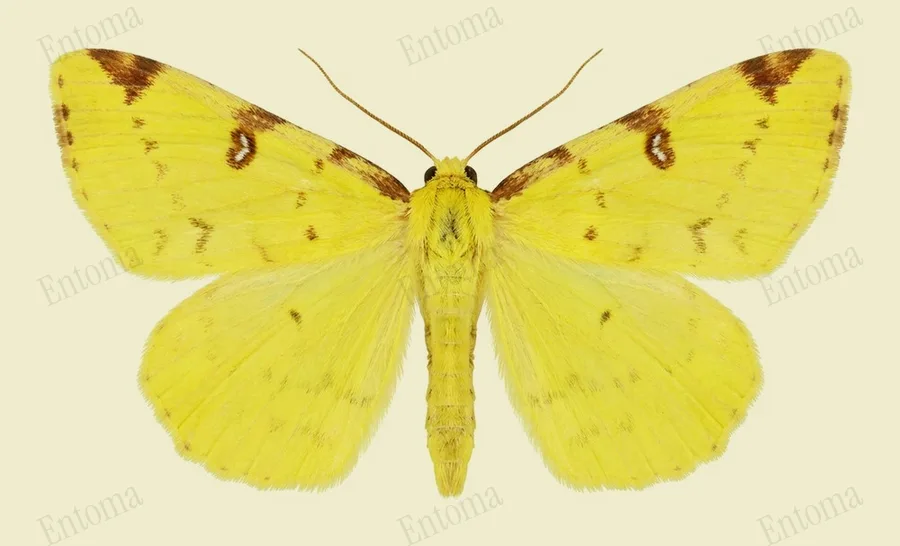
Brimstone moth
In the warmer parts of its range it can complete up to three overlapping generations in a single year, while further north only one brood appears.
| Where | Hedgerows, woodland edges, gardens |
|---|---|
| Size | 33 to 37 mm wingspan |
| When | April to September |
Its wings are a bright lemon yellow with pale brown patches along the leading edge and wingtip and a small white dot on the forewing, spanning roughly 33 to 37 mm.
Caterpillars are loopers that feed on hawthorn and blackthorn, and the adults fly both by day and after dark, when they come readily to light.
Traits
Habitat
Farmland
Colour
Yellow, Brown
Active
Day and night
To people
Harmless
Activity through the year
Often confused with
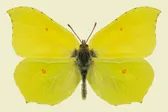
The common brimstone is a true butterfly with clubbed antennae that folds its wings upright at rest, unlike the flat-winged, day-and-night-flying brimstone moth.
Questions
Is the Brimstone moth dangerous to people?
The Brimstone moth is harmless to people.
When can you see the Brimstone moth?
The Brimstone moth can be seen from April to September, by day and at night.
Plate retouched from a photo by David Short from Windsor, UK, CC BY 2.0, Wikimedia Commons Licence
Report a mistake in this entry
Butterflies and moths›Geometer moths›Opisthograptis
Last updated 2026-09-26. Every entry is checked against published sources.