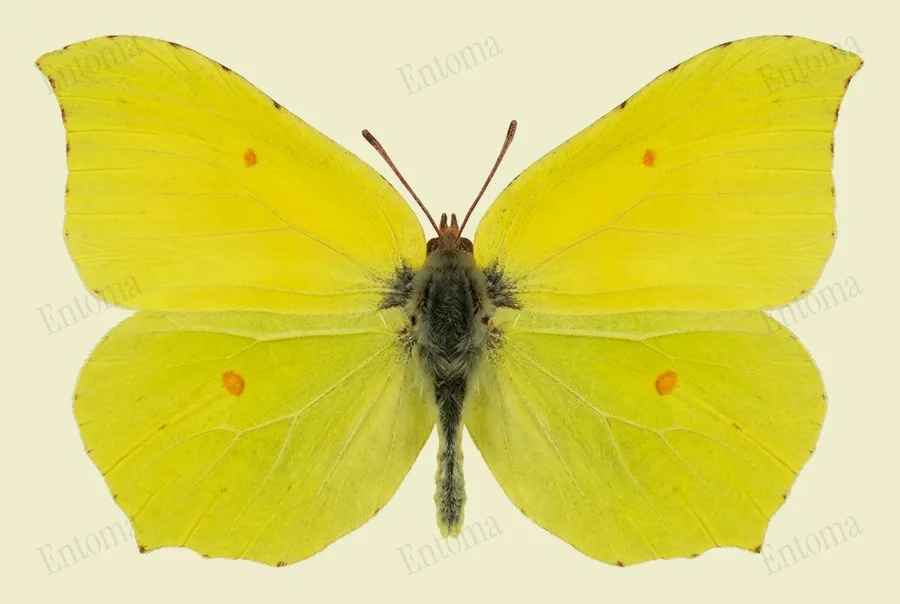
Common brimstone
It always rests with its wings closed, and its leaf-shaped, veined wings camouflage it so well among foliage that it can be almost invisible.
| Where | Woodland edges, hedgerows and scrub with buckthorn |
|---|---|
| Size | 60 to 74 mm wingspan |
| When | March to September |
Males are bright lemon yellow and females much paler greenish-white, both with a small orange spot on each wing and pointed, leaf-shaped tips.
The species overwinters as an adult hidden among evergreen foliage such as ivy or bramble, and emerges on warm days as early as February.
Traits
Habitat
Woodland
Colour
Yellow, Green
Active
Day
To people
Harmless
Activity through the year
Often confused with
The clouded yellow is a deeper orange-yellow with black wing borders visible in flight, while the brimstone is a paler lemon or greenish yellow with no black markings.
Questions
Is the Common brimstone dangerous to people?
The Common brimstone is harmless to people.
When can you see the Common brimstone?
The Common brimstone can be seen from March to September, by day.
Plate retouched from a photo by Didier Descouens, CC BY‑SA 4.0, Wikimedia Commons Licence
The plate on this page is shared under the same licence as its source, CC BY-SA.
Report a mistake in this entry
Butterflies and moths›Whites and yellows›Gonepteryx
Last updated 2026-09-26. Every entry is checked against published sources.