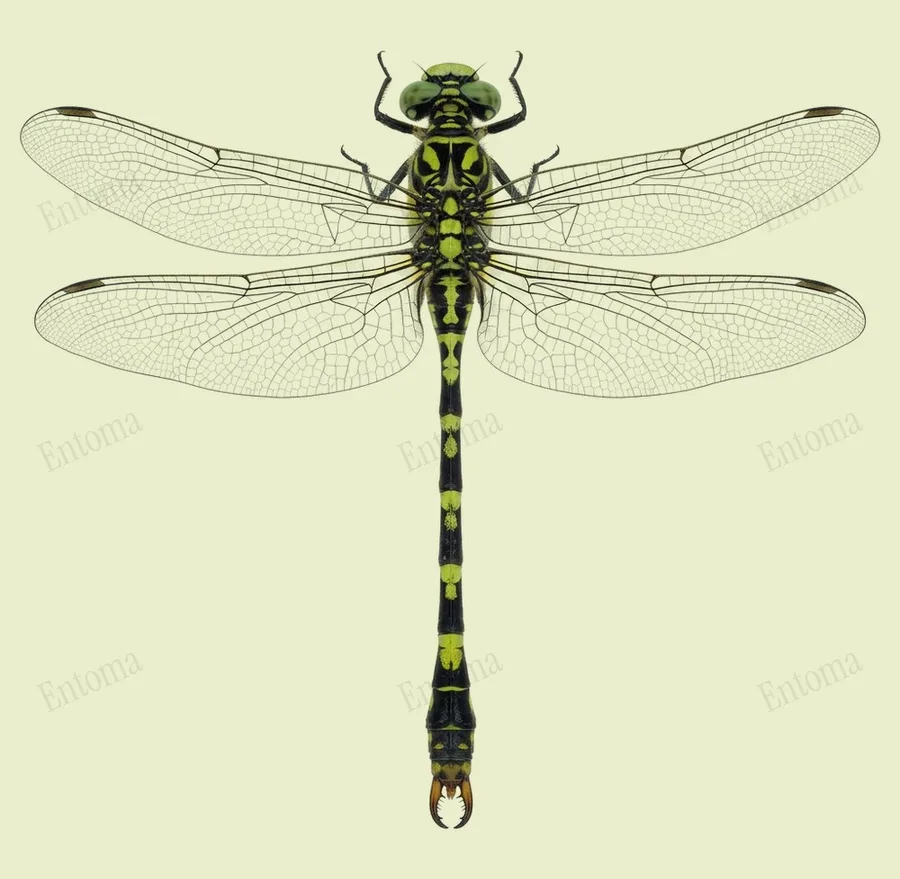
Small pincertail
Males carry three curved hooks at the tip of the abdomen, used to grip a female firmly by the neck during mating.
| Where | Gravelly rivers and streams |
|---|---|
| Size | 55 to 75 mm wingspan |
| When | May to August |
This black and yellow dragonfly has blue-green eyes, green in the north and blue in Mediterranean areas, with two thin, wavy black shoulder stripes on the thorax and a wingspan of about 55 to 75 mm.
Nymphs develop buried in the gravel beds of rivers and streams, and adults patrol the same gravelly waterways, perching on stones or bare ground between short hunting flights.
Traits
Habitat
Wetland
Colour
Black, Yellow, Blue
Active
Day
To people
Harmless; adults do not bite or sting people.
Activity through the year
Often confused with
The large pincertail is bigger, growing up to 65 mm long, and has more extensive black markings across the thorax than the small pincertail's thinner, wavier stripes.
Questions
Is the Small pincertail dangerous to people?
Harmless; adults do not bite or sting people.
When can you see the Small pincertail?
The Small pincertail can be seen from May to August, by day.
Plate retouched from a photo by Слободан Стевчић, CC BY‑SA 4.0, Wikimedia Commons Licence
The plate on this page is shared under the same licence as its source, CC BY-SA.
Report a mistake in this entry
Dragonflies and damselflies›Clubtails›Onychogomphus
Last updated 2026-09-26. Every entry is checked against published sources.