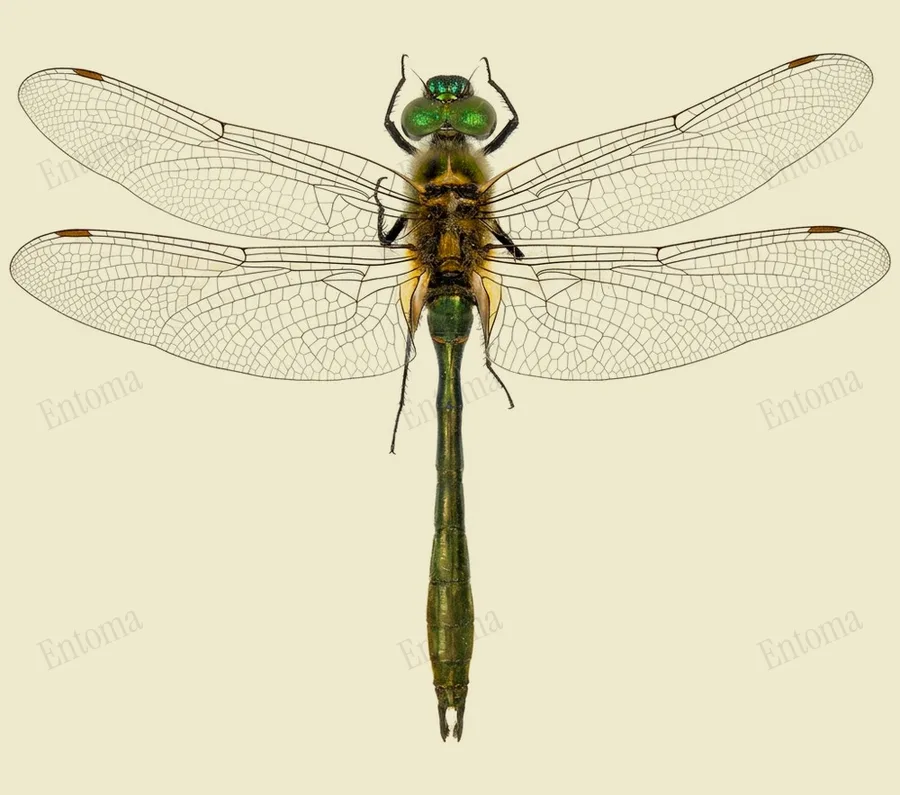
Downy emerald
Its larvae spend two to three years underwater before climbing a waterside stem to transform into a flying adult in a single morning.
| Where | Wooded ponds and lakes |
|---|---|
| Size | 65 to 71 mm wingspan |
| When | April to July |
The downy emerald is a dragonfly with a metallic green to bronze body and bright, apple green eyes, its thorax covered in fine hair that gives it a soft, downy texture. Males have a slightly waisted, club shaped abdomen, while females carry a broader, more evenly rounded one.
Larvae develop for two to three years among leaf litter in still or slow moving water before climbing waterside plant stems in late spring to emerge as adults; the winged dragonflies then patrol wooded ponds and lakes, hunting small flying insects on the wing for about two months.
Traits
Habitat
Wetland
Colour
Green, Metallic
Active
Day
To people
It has no sting and shows no interest in people; it mainly draws the attention of naturalists monitoring pond and lake water quality.
Activity through the year
Often confused with
The brilliant emerald is close in body length at about 50 to 55 mm against 47 to 55 mm in the downy emerald, but it flies later in the season and shows yellow marks on the face that the downy emerald lacks.
Questions
Is the Downy emerald dangerous to people?
It has no sting and shows no interest in people; it mainly draws the attention of naturalists monitoring pond and lake water quality.
When can you see the Downy emerald?
The Downy emerald can be seen from April to July, by day.
Plate retouched from a photo by Göran Liljeberg, CC BY‑SA 3.0, Wikimedia Commons Licence
The plate on this page is shared under the same licence as its source, CC BY-SA.
Report a mistake in this entry
Dragonflies and damselflies›Emeralds›Cordulia
Last updated 2026-09-26. Every entry is checked against published sources.