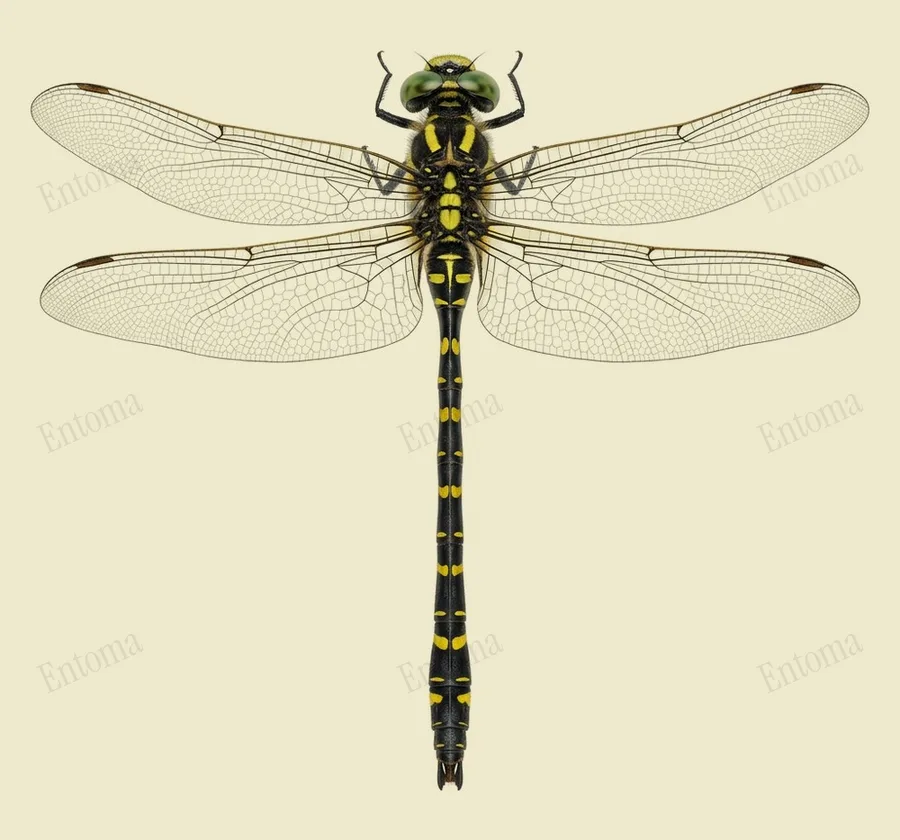
Golden-ringed dragonfly
Females lay eggs by repeatedly jabbing a long ovipositor into the streambed with a bouncing motion, and the aquatic larvae can then take up to seven years to develop.
| Where | Fast streams on heaths and moorland |
|---|---|
| Size | 80 to 101 mm wingspan |
| When | May to September |
The golden-ringed dragonfly is a large black dragonfly ringed with bright yellow bands along the abdomen, with bright green eyes that meet at a point on top of the head. Females carry a long, straight egg-laying tube.
It breeds in fast, acidic streams and small rivers, often through forest, heathland or moorland. Females jab their ovipositor into gravel or silt with a bouncing action to lay eggs, and the aquatic larvae can take up to seven years to develop before emerging as adults.
Traits
Habitat
Wetland
Colour
Black, Yellow, Green
Active
Day
To people
Harmless; despite its size and loud flight, it cannot sting people.
Activity through the year
Often confused with
The sombre goldenring looks almost identical but breeds in small mountain springs and headwater trickles rather than the larger streams the golden-ringed dragonfly favours, and males have two teeth on the upper anal appendages instead of one.
Questions
Is the Golden-ringed dragonfly dangerous to people?
Harmless; despite its size and loud flight, it cannot sting people.
When can you see the Golden-ringed dragonfly?
The Golden-ringed dragonfly can be seen from May to September, by day.
Plate retouched from a photo by Moore, N, CC BY 4.0, Wikimedia Commons Licence
Report a mistake in this entry
Dragonflies and damselflies›Goldenrings›Cordulegaster
Last updated 2026-09-26. Every entry is checked against published sources.