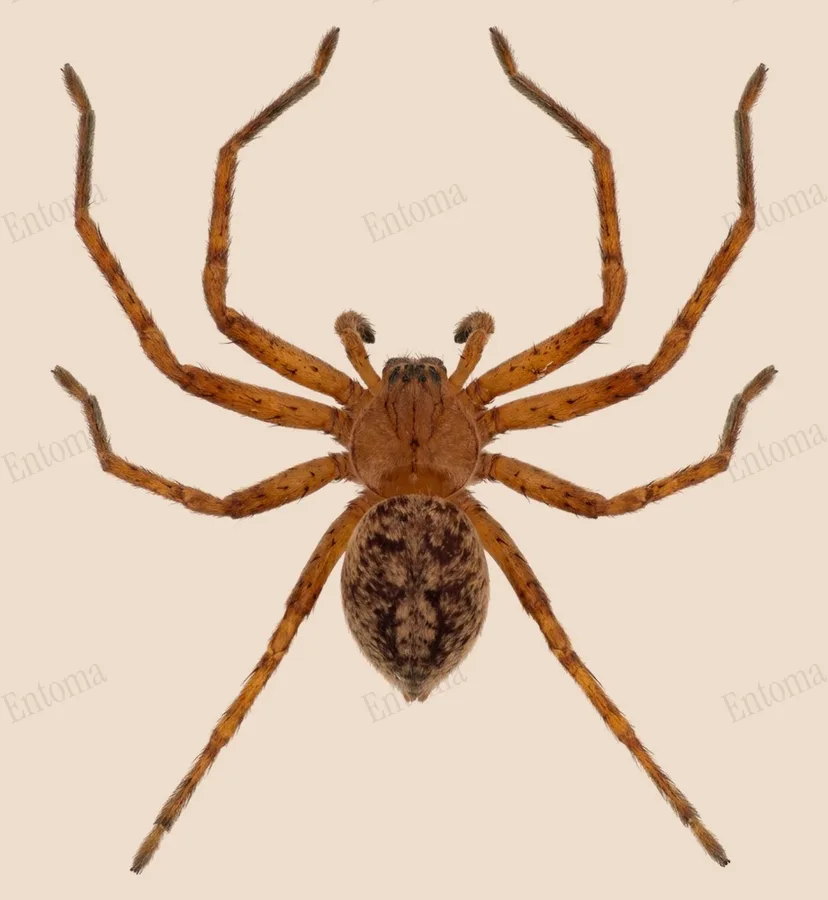
Olios argelasius
Adult females guard their egg sac and continue to bring food to the spiderlings after they hatch, unusual parental care among huntsman spiders of warm dry Europe.
| Where | Warm walls and rocky ground, Mediterranean Europe |
|---|---|
| Size | Female 10.6 to 17 mm, male 7.4 to 11 mm body length |
| When | February to December |
This huntsman spider has a yellowish brown body with a grey spear shaped mark on the abdomen followed by dark angled spots, darker leg tips, and notably long legs built for fast climbing on vertical rock and walls.
It hides under stones by day in hot, sparsely vegetated ground and becomes active on rocks and walls at night, hunting without a web; females also show unusually attentive care of their egg sac and newly hatched young.
Traits
Habitat
Towns
Colour
Brown, Yellow, Grey
Active
Night
To people
This fast climbing huntsman has no documented bite to people; if found indoors at night, it can be covered with a cup and carried back outside.
Activity through the year
Often confused with
The Nosferatu spider carries a distinctive dark, flared mark on the front of the abdomen resembling a face, quite unlike the plain grey spear mark and dark angled spots of Olios argelasius, and it often shelters indoors rather than under stones.
Questions
Is Olios argelasius dangerous to people?
This fast climbing huntsman has no documented bite to people; if found indoors at night, it can be covered with a cup and carried back outside.
When can you see Olios argelasius?
Olios argelasius can be seen from February to December, at night.
Plate retouched from a photo by Ludivine Lamare, CC BY 4.0, iNaturalist Licence
Report a mistake in this entry
Spiders›Huntsman spiders›Olios
Last updated 2026-09-27. Every entry is checked against published sources.