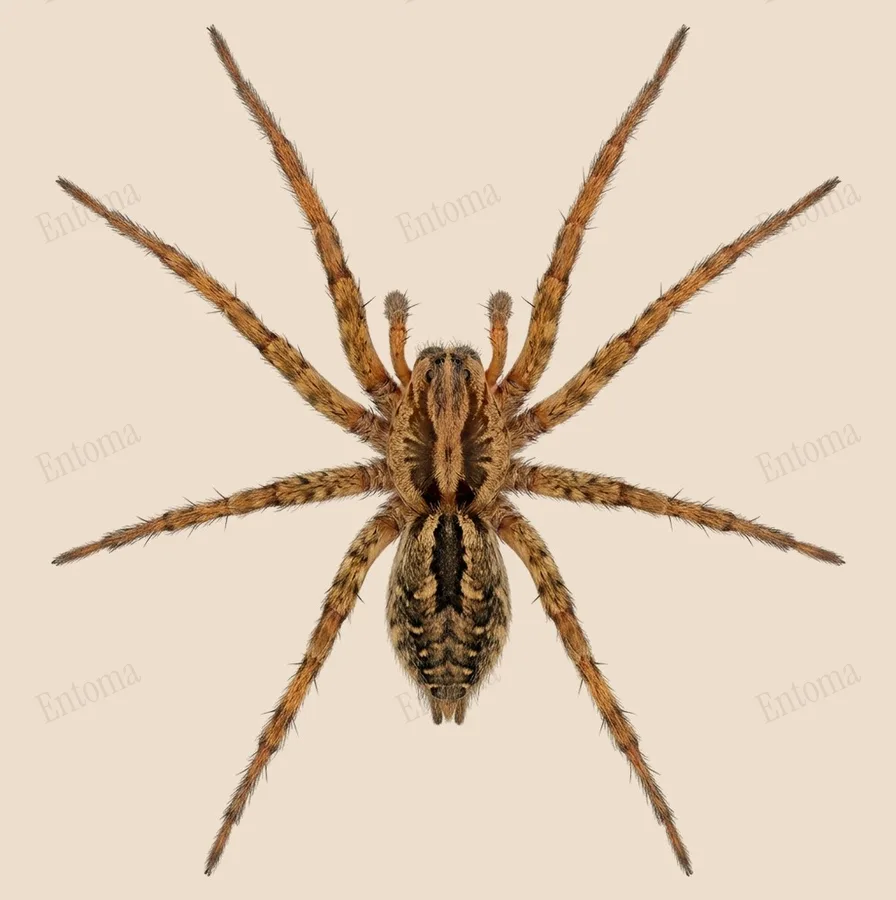
Labyrinth spider
Even in complete darkness this spider can find its way back through its own silk tunnel to the exact spot where prey struck the web.
| Where | Long grass, hedgerows and low trees |
|---|---|
| Size | Male 8 to 14 mm, female 10 to 18 mm body length |
| When | May to August |
The labyrinth spider is a large funnel-web spider with a yellowish-brown head marked by two broad dark stripes and a blackish abdomen bearing a broad reddish central band edged with pale yellow chevrons. Females measure 10 to 18 mm in body length and males somewhat less, at 8 to 14 mm.
It spreads a broad, flat sheet web across low, dense vegetation such as long grass and hedgerows, connected to a narrow silk tunnel where it waits with its front legs resting on the threads. Guided by fine sensory hairs on its legs, it can navigate back through the tunnel to any point on the web the instant it feels a vibration.
Traits
Habitat
Grassland
Colour
Brown, Yellow
Active
Day and night
To people
Not known to bite people; it stays hidden in its silk tunnel and rushes out only to seize insects that land on its web.
Activity through the year
Often confused with
Textrix denticulata is distinctly smaller, up to about 9 mm, and spins a much smaller funnel web on tree bark, stone walls and rocky ground rather than the large sheet web the labyrinth spider builds low in dense grass and hedgerows.
Questions
Is the Labyrinth spider dangerous to people?
Not known to bite people; it stays hidden in its silk tunnel and rushes out only to seize insects that land on its web.
When can you see the Labyrinth spider?
The Labyrinth spider can be seen from May to August, by day and at night.
Plate retouched from a photo by ajott, CC BY 4.0, iNaturalist Licence
Report a mistake in this entry
Spiders›Funnel weavers›Agelena
Last updated 2026-09-27. Every entry is checked against published sources.