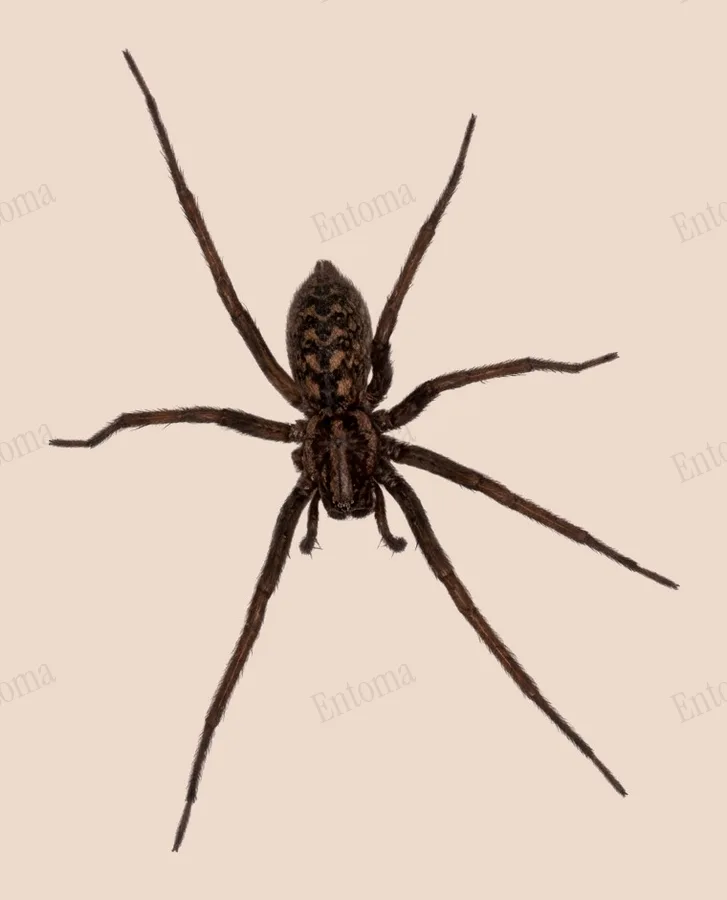
Giant house spider
Despite its fearsome size, its bite is so weak that most people never feel it break the skin, and it usually flees rather than bites at all.
| Where | Buildings, cellars and stone crevices |
|---|---|
| Size | Male 10 to 15 mm, female 11 to 18.5 mm body length |
| When | January to November |
The giant house spider is a large, fast-moving spider with a yellowish-grey head marked by two broad dark stripes, and a grey-brown abdomen carrying two rows of pale yellow spots down a slender central line. Females reach about 11 to 18.5 mm in body length and males 10 to 15 mm, with even longer legs.
It builds flat, funnel-shaped webs under stones and inside buildings, especially in cellars, wall cavities and quiet corners, and is one of the fastest spiders known for its running speed. Males wander widely through houses in late summer and autumn searching for mates, which is when most people encounter this species indoors.
Traits
Habitat
Towns
Colour
Grey, Brown, Yellow
Active
Night
To people
Mild
Bites are very rare and happen mostly when the spider is grabbed by hand; when they do occur, they cause only brief, mild pain and local swelling.
Activity through the year
Often confused with
The common house spider is clearly smaller, up to about 11.5 mm, with a plain light grey abdomen marked only by darker chevrons, lacking the paired yellow spots and slender yellow stripe of the giant house spider.
Questions
Is the Giant house spider dangerous to people?
Mild. Bites are very rare and happen mostly when the spider is grabbed by hand; when they do occur, they cause only brief, mild pain and local swelling.
When can you see the Giant house spider?
The Giant house spider can be seen from January to November, at night.
Plate retouched from a photo by Michael Grundner, CC BY 4.0, iNaturalist Licence
Report a mistake in this entry
Spiders›Funnel weavers›Eratigena
Last updated 2026-09-27. Every entry is checked against published sources.