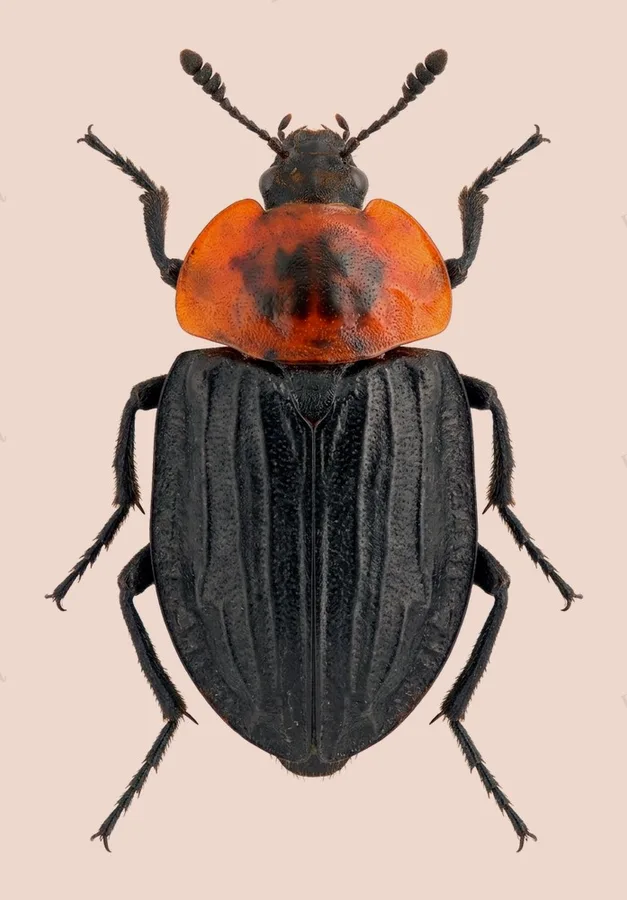
Red-breasted carrion beetle
Despite gathering at carcasses, this beetle avoids the flesh itself and instead hunts the fly larvae that swarm over dead birds and small mammals.
| Where | Woodland floor near carcasses |
|---|---|
| Size | 11 to 16 mm body length |
| When | March to August |
This two-toned beetle has a bright red-orange pronotum contrasting with a dark grey to black body and ridged wing cases, making it one of the more distinctive carrion beetles.
Adults and larvae gather on and under the carcasses of birds and small mammals, but rather than eating the carrion itself, they hunt fly larvae and other insects feeding on the remains; strong-flying adults climb grass stems before taking off.
Traits
Habitat
Woodland
Colour
Red, Black
Active
Day and night
To people
Hunts fly larvae at carcasses rather than feeding on carrion itself; harmless to people.
Activity through the year
Often confused with
Larger at about 15 to 25 mm, with a shiny all-black body and a distinct bump partway down each wing case, unlike the smaller Red-breasted carrion beetle's contrasting red-orange pronotum.
Questions
Is the Red-breasted carrion beetle dangerous to people?
Hunts fly larvae at carcasses rather than feeding on carrion itself; harmless to people.
When can you see the Red-breasted carrion beetle?
The Red-breasted carrion beetle can be seen from March to August, by day and at night.
Plate retouched from a photo by Francisco Welter-Schultes, CC0, Wikimedia Commons Licence
Report a mistake in this entry
Beetles›Rove beetles›Oiceoptoma
Last updated 2026-09-26. Every entry is checked against published sources.