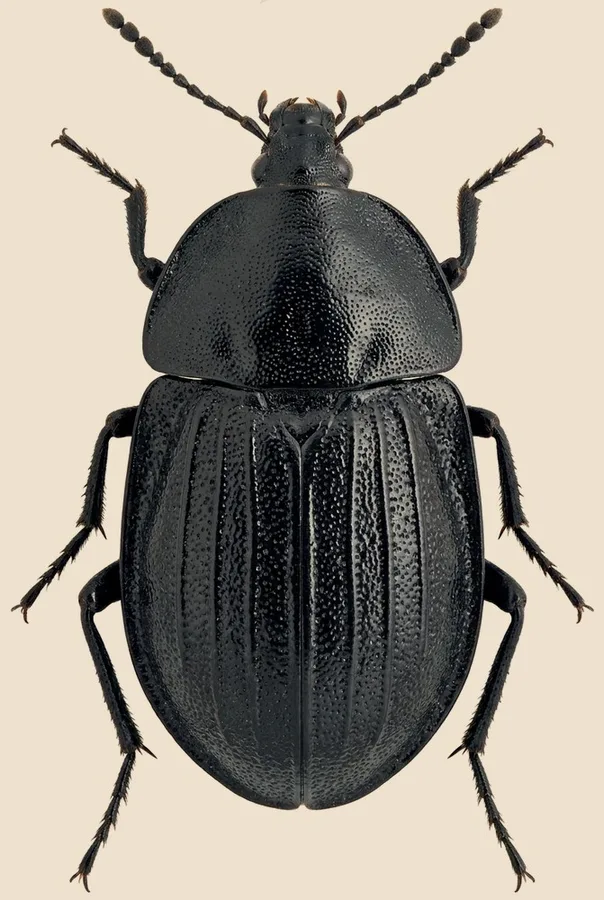
Black snail beetle
It hunts snails by pushing its narrow, elongated head into the shell and injecting saliva that dissolves the prey's tissue over many hours.
| Where | Woodland, grassland, and gardens |
|---|---|
| Size | 10 to 15 mm long |
| When | January to December |
This shiny black beetle has a narrow head and long neck adapted for reaching deep into snail shells, with broadly spaced ridges running the length of its wing cases. It measures 10 to 15 mm long and cannot fly.
Mostly nocturnal, it hides under logs and leaf litter by day and can spend more than twelve hours feeding on a single snail, staying active in most months of the year.
Traits
Habitat
Woodland
Colour
Black
Active
Night
To people
Harmless to people; it feeds only on snails.
Activity through the year
Often confused with
The obscure carrion beetle is larger and noticeably rounder and more massive bodied at 14 to 18 mm, unlike the black snail beetle's slimmer form and narrow, elongated head.
Questions
Is the Black snail beetle dangerous to people?
Harmless to people; it feeds only on snails.
When can you see the Black snail beetle?
The Black snail beetle can be seen from January to December, at night.
Plate retouched from a photo by Francisco Welter-Schultes, CC0, Wikimedia Commons Licence
Report a mistake in this entry
Beetles›Rove beetles›Phosphuga
Last updated 2026-09-26. Every entry is checked against published sources.