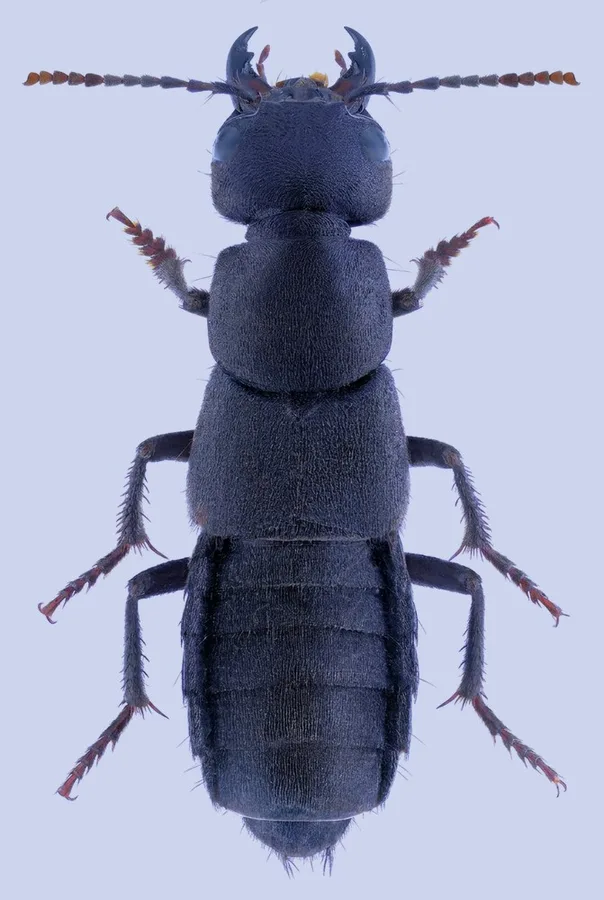
Devil's coach horse beetle
When threatened it curls its abdomen upward like a scorpion and can release a foul smell, but it has no sting and no venom at all.
| Where | Woodland, gardens and grassland |
|---|---|
| Size | 20 to 32 mm long |
| When | April to November |
The whole beetle is matte black with long, exposed abdominal segments and short elytra that leave most of the abdomen uncovered, giving it an elongated, almost scorpion-like silhouette. It moves quickly on the ground and carries strong, pincer-like jaws.
It hides by day under logs, stones and leaf litter and hunts mainly at night, using its powerful mandibles to catch slugs, snails, worms and other invertebrates.
Traits
Habitat
Garden
Colour
Black
Active
Night
To people
Mild
Can give a painful bite with its large jaws if handled, but it is not dangerous to people.
Activity through the year
Often confused with
Tasgius ater is a stout black rove beetle too, but it tops out around 15 mm, well under half the length of a full-grown devil's coach horse.
Questions
Is the Devil's coach horse beetle dangerous to people?
Mild. Can give a painful bite with its large jaws if handled, but it is not dangerous to people.
When can you see the Devil's coach horse beetle?
The Devil's coach horse beetle can be seen from April to November, at night.
Plate retouched from a photo by URSchmidt, CC BY‑SA 4.0, Wikimedia Commons Licence
The plate on this page is shared under the same licence as its source, CC BY-SA.
Report a mistake in this entry
Last updated 2026-09-26. Every entry is checked against published sources.