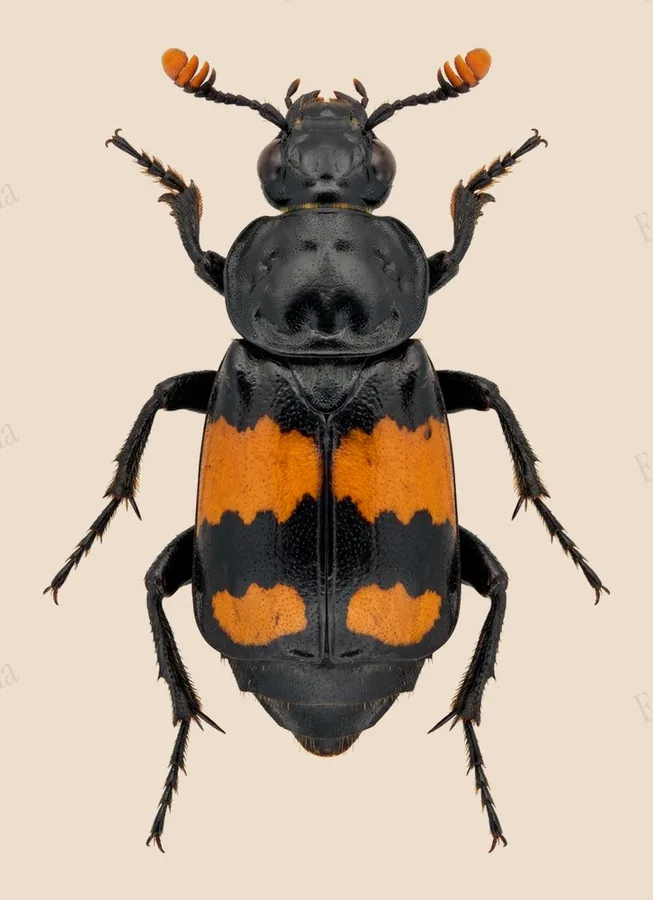
Lesser vespillo burying beetle
A mating pair strips fur from a dead mouse or bird, buries it, then feeds their larvae by regurgitating flesh straight into their mouths.
| Where | Woodland, gardens and other places with carrion |
|---|---|
| Size | 12 to 20 mm body length |
| When | April to October |
The body is black with two broad orange-yellow bands crossing the wing covers, which are short and squarish, leaving part of the abdomen exposed. The antennae are entirely black, unlike the orange-tipped antennae of the similar common sexton beetle.
A male and female work together to find and bury a small carcass, removing fur or feathers and coating it with antimicrobial secretions before both parents feed the larvae by regurgitation, an unusually developed form of care for a beetle.
Traits
Habitat
Woodland
Colour
Black, Orange
Active
Night
To people
Harmless to people; adults are sometimes drawn to outdoor lights after dark.
Activity through the year
Often confused with
Similar in size, 12 to 22 mm, but identified by orange tipped antennal clubs, whereas the lesser vespillo burying beetle has entirely black antennae.
Questions
Is the Lesser vespillo burying beetle dangerous to people?
Harmless to people; adults are sometimes drawn to outdoor lights after dark.
When can you see the Lesser vespillo burying beetle?
The Lesser vespillo burying beetle can be seen from April to October, at night.
Plate retouched from a museum specimen photo by Aleksi Lapakko, Finnish Biodiversity Information Facility, CC BY 4.0, GBIF Licence
Report a mistake in this entry
Beetles›Rove beetles›Nicrophorus
Last updated 2026-09-26. Every entry is checked against published sources.