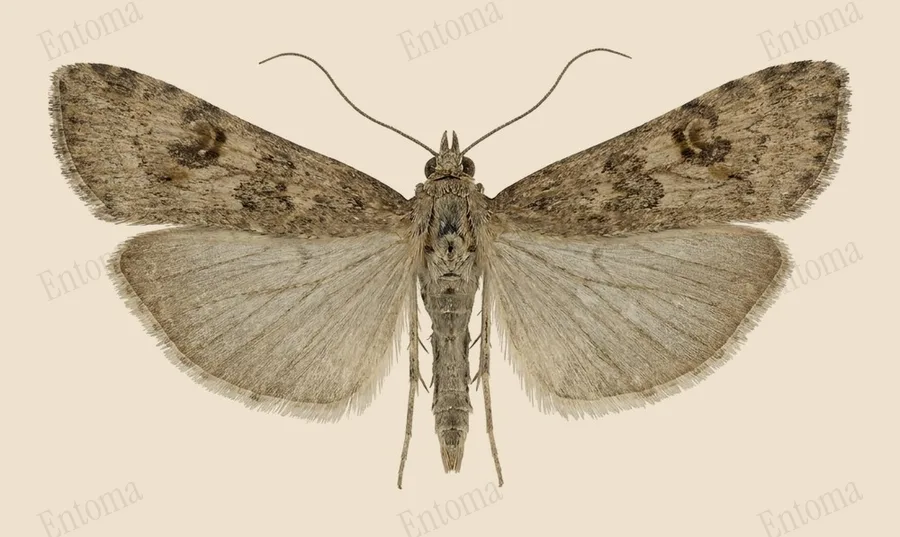
Rush veneer
This narrow-winged moth migrates north from southern Europe and North Africa each year, sometimes arriving at coastal light traps in large numbers.
| Where | Grassland, farmland and coastal areas |
|---|---|
| Size | 26 to 32 mm wingspan |
| When | June to October |
The Rush veneer holds its narrow wings tightly folded along the body at rest, giving it an elongated, torpedo-like shape quite different from most other grass moths, with brownish forewings marked by darker figure-eight shaped patches.
It is a strong migrant, moving north from southern Europe and North Africa in varying numbers each year, and the caterpillars feed on clover and various grasses through the warmer months.
Traits
Habitat
Grassland
Colour
Brown
Active
Night
To people
Attracted to light; harmless to people.
Activity through the year
Often confused with
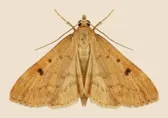
Noticeably smaller at 18 to 22 mm wingspan, with broader, more triangular wings and rusty orange-brown markings rather than the narrow, torpedo-shaped profile of the Rush veneer.
Questions
Is the Rush veneer dangerous to people?
Attracted to light; harmless to people.
When can you see the Rush veneer?
The Rush veneer can be seen from June to October, at night.
Plate retouched from a photo by Hsu Hong Lin from 南投縣集集鎮, 中華民國, CC BY 2.0, Wikimedia Commons Licence
Report a mistake in this entry
Butterflies and moths›Grass moths›Nomophila
Last updated 2026-09-26. Every entry is checked against published sources.