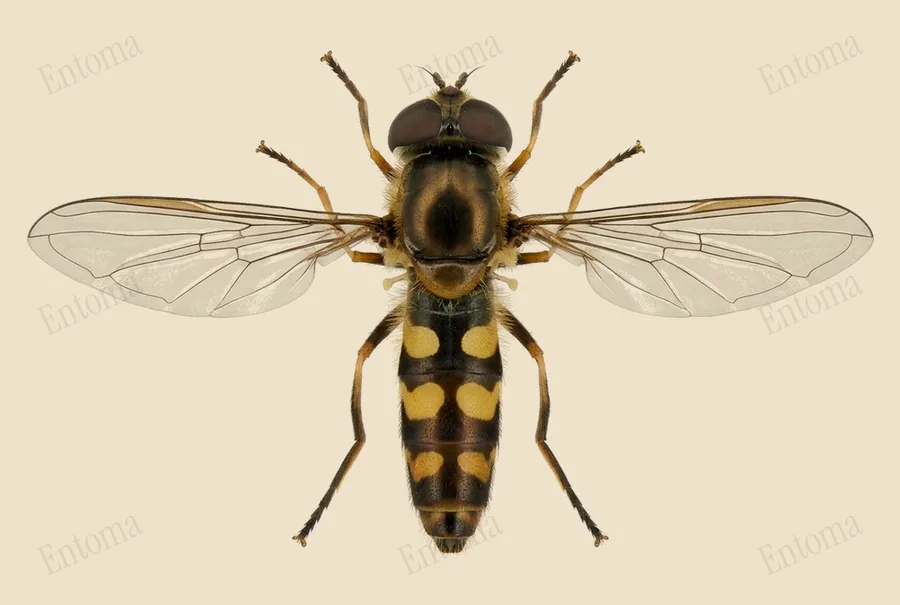
Spotted thintail
Its larvae hide among aphid colonies on trees, yet the adult fly can be seen on the wing in every month except January.
| Where | Woodland edges and mature gardens |
|---|---|
| Size | 6 to 9.5 mm long |
| When | February to December |
This slender hoverfly has a shiny brown thorax, a yellow scutellum, red eyes, and a black abdomen marked with pale yellow elliptical patches, the whole fly measuring roughly 6 to 9.5 mm long.
Larvae feed on aphids and psyllids on trees and shrubs such as elder and Berberis, and adults frequent woodland edges and mature gardens across Europe, sometimes overwintering to appear on mild winter days.
Traits
Habitat
Woodland
Colour
Brown, Yellow, Black
Active
Day
To people
Harmless; it does not bite or sting.
Activity through the year
Often confused with
This close relative has broader, squarer yellow markings on the second abdominal segment and an entirely yellow face, and is slightly larger at 7 to 9.75 mm long.
Questions
Is the Spotted thintail dangerous to people?
Harmless; it does not bite or sting.
When can you see the Spotted thintail?
The Spotted thintail can be seen from February to December, by day.
Plate retouched from a photo by Rego et al. (2022), CC BY 4.0, Wikimedia Commons Licence
Report a mistake in this entry
Last updated 2026-09-26. Every entry is checked against published sources.