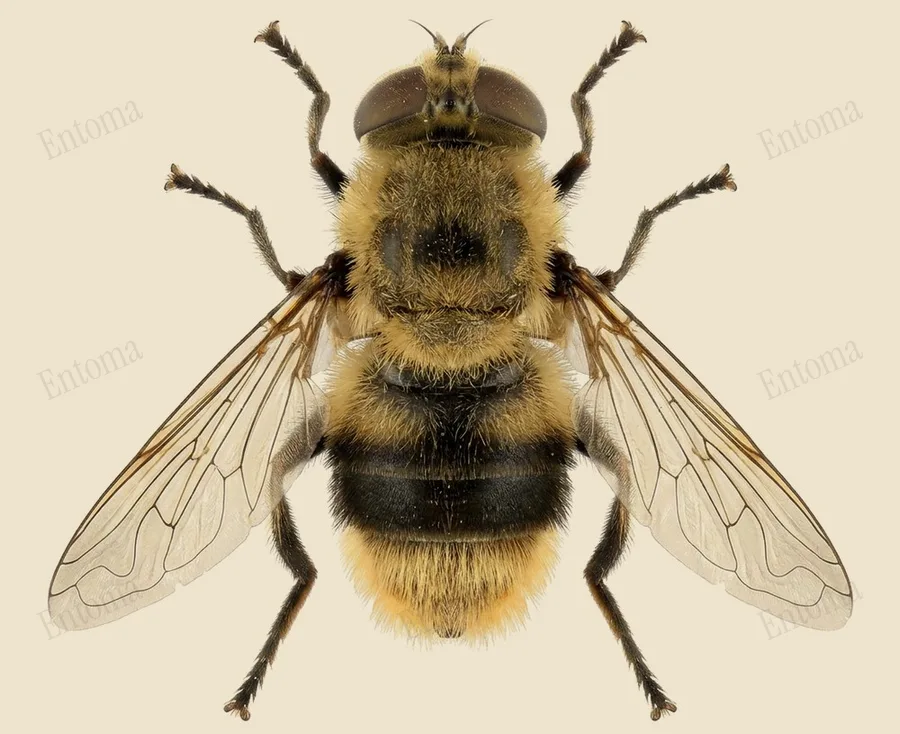
Narcissus bulb fly
Adult Narcissus bulb flies come in several different hairy color patterns, each one mimicking a different bumblebee species, while their legless larvae hollow out daffodil and bluebell bulbs.
| Where | Gardens, grassland and daffodil beds |
|---|---|
| Size | 12 to 15 mm body length |
| When | April to July |
Covered in ginger hairs with a dark band around the middle and a pale creamy tail, the Narcissus bulb fly is one of several hoverflies that mimic bumblebees, though its all black legs and single pair of wings give it away.
Females lay eggs on the dying leaves of daffodils and other bulbous plants, and the resulting larvae burrow underground to feed inside the bulb, sometimes destroying it before the following season.
Traits
Habitat
Garden
Colour
Orange, Black
Active
Day
To people
Harmless to people despite its bumblebee disguise; the real damage, if any, falls on bulbs rather than skin.
Activity through the year
Often confused with
Similar in size at about 11 to 17 mm, but this mimic has plume-like bristles on its antennae and comes in red-tailed or white-tailed bumblebee color forms, while the Narcissus bulb fly is itself strongly polymorphic, with several color forms that each mimic a different bumblebee species rather than one ginger and black pattern.
Questions
Is the Narcissus bulb fly dangerous to people?
Harmless to people despite its bumblebee disguise; the real damage, if any, falls on bulbs rather than skin.
When can you see the Narcissus bulb fly?
The Narcissus bulb fly can be seen from April to July, by day.
Plate retouched from a museum specimen photo by Olga Borodina, University of Tartu, Natural History Museum and Botanical Garden, CC BY 4.0, GBIF Licence
Report a mistake in this entry
Last updated 2026-09-26. Every entry is checked against published sources.