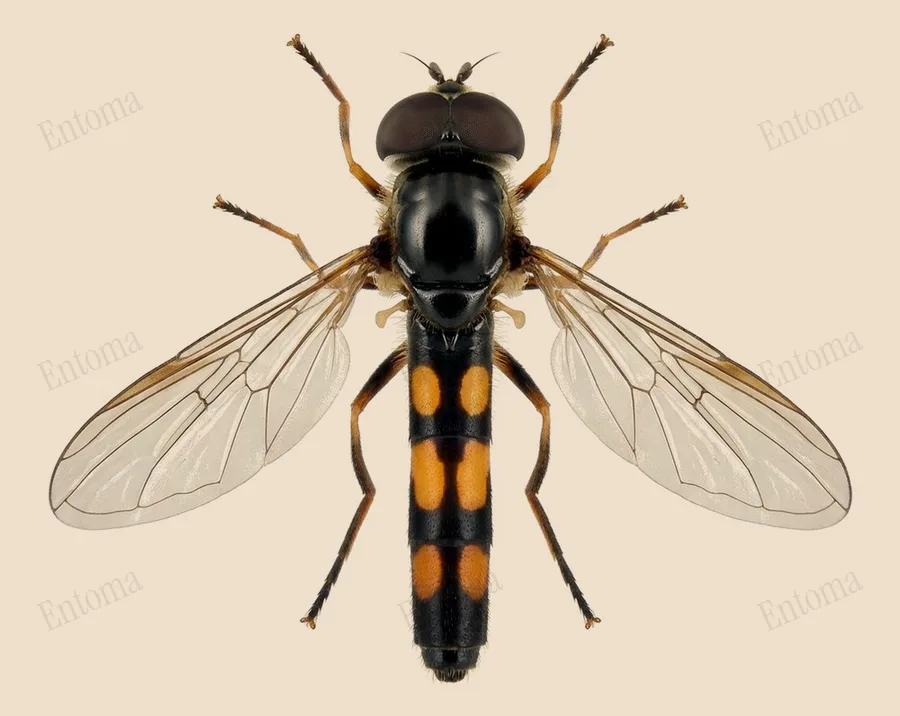
Ladder-backed hover fly
Males of this slender hoverfly have long abdomens marked with lozenge shaped yellow spots, while females carry triangular spots of the same color instead.
| Where | Grassy areas, woodland rides and gardens |
|---|---|
| Size | 7 to 10 mm body length |
| When | March to October |
This slender hoverfly has a shiny black thorax and a black abdomen crossed by yellow markings, with yellow antennae in both sexes. Males are more elongated with lozenge shaped yellow spots, while the shorter, broader females show triangular spots instead.
Larvae hunt aphids among grass and low herbage, helping to keep populations of these sap feeding insects in check, while adults feed on pollen and nectar in grassy places and woodland edges from spring into autumn.
Traits
Habitat
Grassland
Colour
Black, Yellow
Active
Day
To people
Feeds on pollen and nectar and neither bites nor stings people.
Activity through the year
Often confused with
Similar in appearance but slightly smaller, with a wing length of about 4.7 to 7 mm, a shiny black face and a less slender build than the Ladder-backed hover fly.
Questions
Is the Ladder-backed hover fly dangerous to people?
Feeds on pollen and nectar and neither bites nor stings people.
When can you see the Ladder-backed hover fly?
The Ladder-backed hover fly can be seen from March to October, by day.
Plate retouched from a museum specimen photo by Olga Borodina, University of Tartu, Natural History Museum and Botanical Garden, CC BY 4.0, GBIF Licence
Report a mistake in this entry
Last updated 2026-09-26. Every entry is checked against published sources.