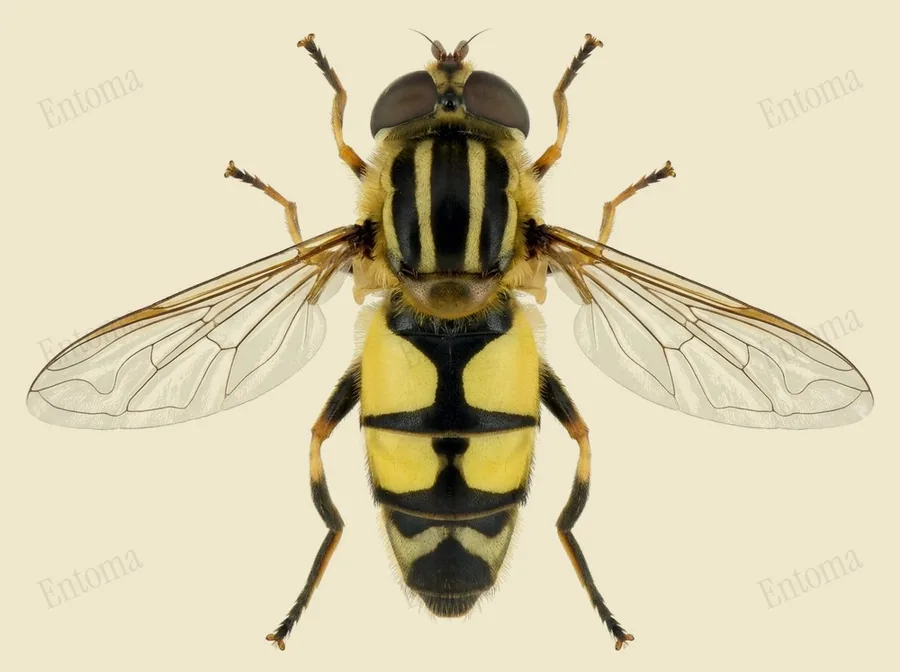
Trivittate marsh fly
Its genus name combines Greek words for marsh and friend, fitting a hoverfly that suns itself on wet meadow leaves near standing water.
| Where | Wet meadows and flower rich edges |
|---|---|
| Size | 14 to 18 mm long |
| When | May to September |
This hoverfly has a black thorax crossed by four narrow, pale yellow stripes and an abdomen patterned in a single, uniform lemon yellow rather than the warmer orange tones of related species. Adults reach 14 to 18 mm long.
It favors sunny, flower rich meadows and wetland edges with organically enriched water, where larvae develop, and adults are often seen basking on fresh leaves from May to September.
Traits
Habitat
Wetland
Colour
Black, Yellow
Active
Day
To people
Harmless to people.
Activity through the year
Often confused with
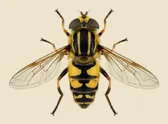
The footballer is smaller, reaching only about 13 mm, and has warmer orange toned abdominal markings and a black facial stripe, compared with this species' pale lemon yellow markings and yellow facial stripe.
Questions
Is the Trivittate marsh fly dangerous to people?
Harmless to people.
When can you see the Trivittate marsh fly?
The Trivittate marsh fly can be seen from May to September, by day.
Plate retouched from a photo by Quartl, CC BY‑SA 3.0, Wikimedia Commons Licence
The plate on this page is shared under the same licence as its source, CC BY-SA.
Report a mistake in this entry
Last updated 2026-09-26. Every entry is checked against published sources.