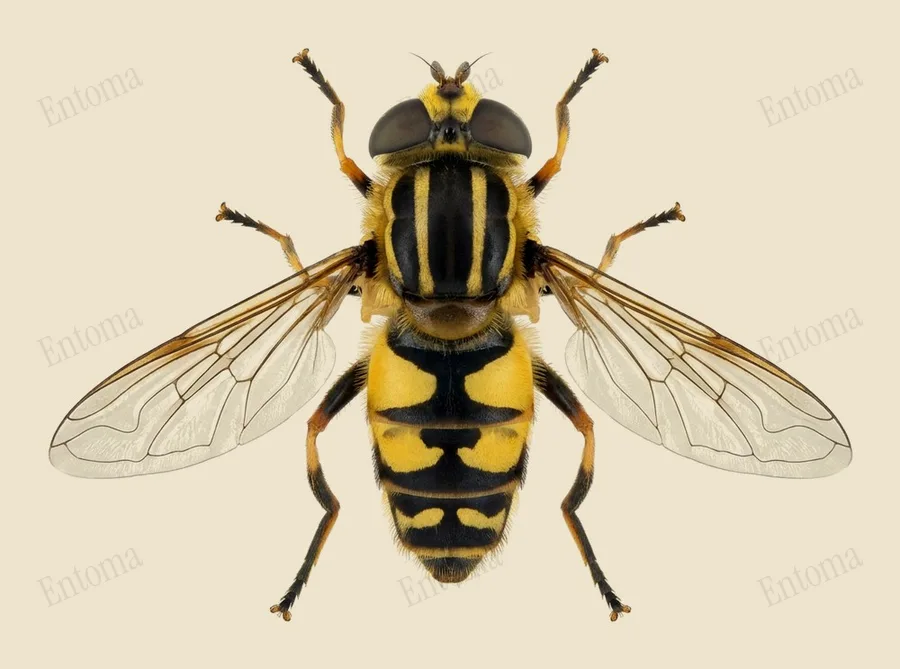
Sun fly
Its bold black and yellow striped abdomen has earned it the nickname 'the footballer' among naturalists.
| Where | Pond edges, ditches, gardens and hedgerows |
|---|---|
| Size | 9 to 13 mm body length |
| When | April to October |
A medium-sized hoverfly with black and yellow stripes running lengthwise on the thorax and a grey, black and yellow patterned abdomen; the hind legs are orange for most of their length.
Larvae are 'rat-tailed maggots' that live in muddy water, wet compost or manure, breathing through a long extendable tail tube.
Traits
Habitat
Wetland
Colour
Black, Yellow, Grey
Active
Day
To people
Harmless fly; cannot bite or sting
Activity through the year
Often confused with
Large tiger hoverfly is bigger and paler, with the hind tibiae almost entirely orange, whereas the sun fly's hind tibiae are orange only on the basal two-thirds.
Questions
Is the Sun fly dangerous to people?
Harmless fly; cannot bite or sting.
When can you see the Sun fly?
The Sun fly can be seen from April to October, by day.
Plate retouched from a photo by Michael Garlick, CC BY‑SA 2.0, Wikimedia Commons Licence
The plate on this page is shared under the same licence as its source, CC BY-SA.
Report a mistake in this entry
Last updated 2026-09-26. Every entry is checked against published sources.