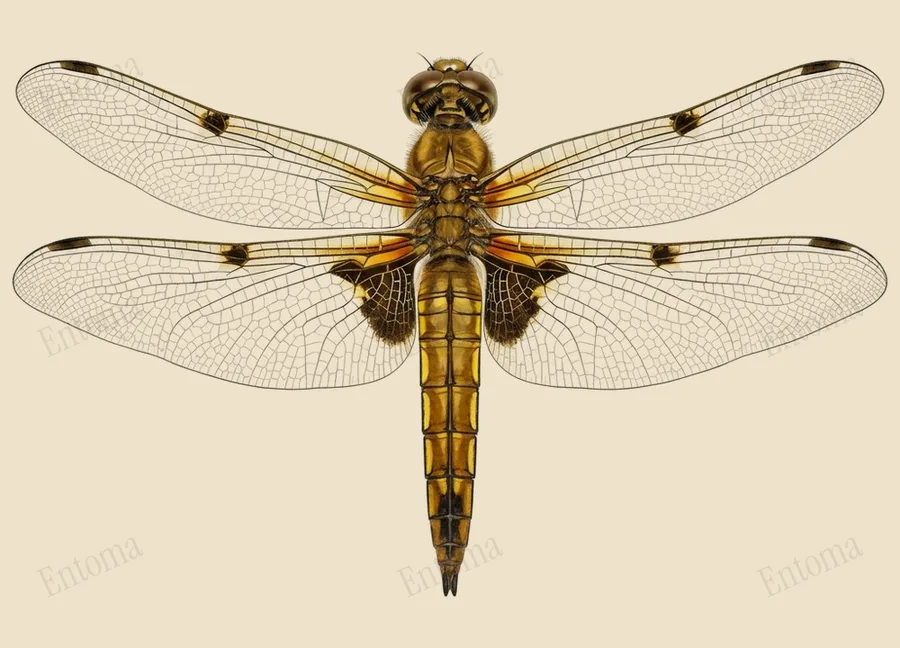
Four-spotted chaser
Every wing carries two dark spots along its leading edge, giving this dragonfly four spots in total and its common name.
| Where | Ponds, lakes, heathland pools |
|---|---|
| Size | 74 to 78 mm wingspan |
| When | April to August |
It is a fairly large, yellowish-brown dragonfly, palest near the thorax and darkening toward the tip of the abdomen, with a small dark spot in the middle of each wing's leading edge plus one near each wingtip.
Nymphs live in still water for two years or more before climbing emergent vegetation to complete their final moult, and the adults feed on midges, gnats and mosquitoes caught in flight.
Traits
Habitat
Wetland
Colour
Brown, Yellow
Active
Day
To people
Harmless; does not bite or sting people
Activity through the year
Often confused with
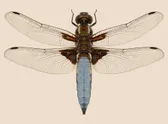
The broad-bodied chaser has a much wider, flattened abdomen and mature males turn powder blue, unlike the more slender, yellow-brown four-spotted chaser.
Questions
Is the Four-spotted chaser dangerous to people?
Harmless; does not bite or sting people.
When can you see the Four-spotted chaser?
The Four-spotted chaser can be seen from April to August, by day.
Plate retouched from a photo by spacebirdy(also known as geimfyglið (:> )=| made with Sternenlaus-spirit), CC BY‑SA 3.0, Wikimedia Commons Licence
The plate on this page is shared under the same licence as its source, CC BY-SA.
Report a mistake in this entry
Dragonflies and damselflies›Skimmers›Libellula
Last updated 2026-09-26. Every entry is checked against published sources.