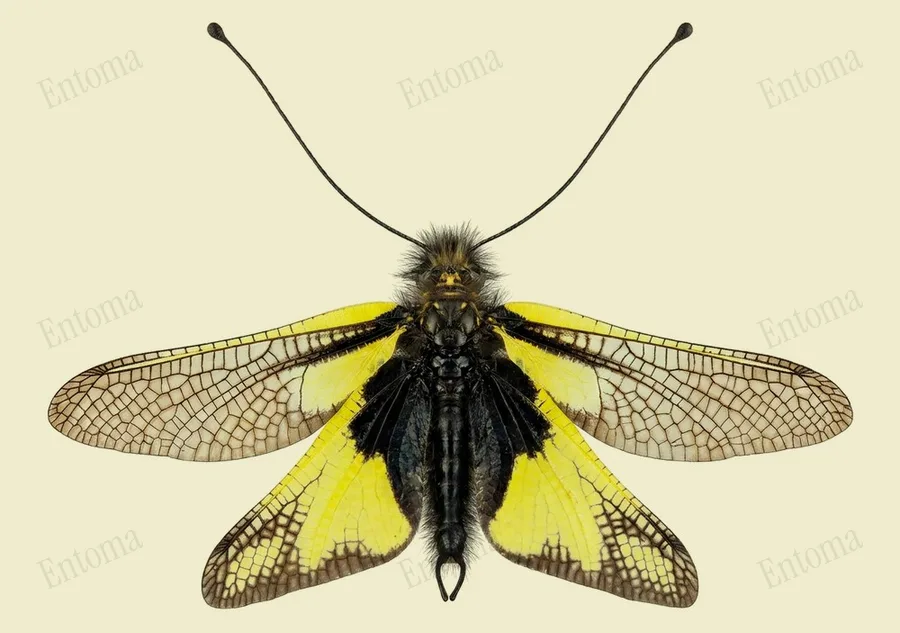
Owly sulphur
Despite its dragonfly-like flight and huge clubbed antennae, this owlfly is actually a lacewing relative, not a dragonfly or a butterfly.
| Where | Dry grassland and sunny rocky slopes |
|---|---|
| Size | 45 to 55 mm wingspan |
| When | April to July |
It has a black, hairy body, large bulging eyes and long antennae ending in a distinct club, with partly transparent wings that show bold yellow patches near the base and dark brown along the outer edge.
It flies on sunny days over dry grassland, rocky slopes and flower-rich scrubland, sometimes up to 1,500 metres elevation, hunting other flying insects on the wing.
Traits
Habitat
Grassland
Colour
Black, Yellow, Brown
Active
Day
To people
Harmless
Activity through the year
Often confused with
Its dark wing base does not reach the hindwing's rear edge and its yellow wing veining is subtler than the bolder pattern of Libelloides coccajus.
Questions
Is the Owly sulphur dangerous to people?
The Owly sulphur is harmless to people.
When can you see the Owly sulphur?
The Owly sulphur can be seen from April to July, by day.
Plate retouched from a photo by Gllawm, CC BY‑SA 4.0, Wikimedia Commons Licence
The plate on this page is shared under the same licence as its source, CC BY-SA.
Report a mistake in this entry
Lacewings›Owlflies›Libelloides
Last updated 2026-09-26. Every entry is checked against published sources.