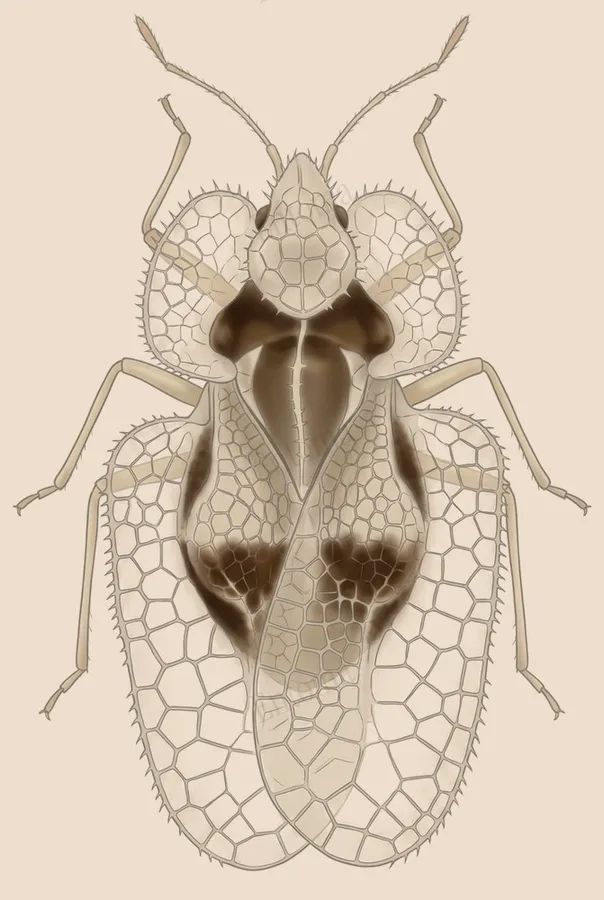
Eastern sycamore lace bug
In late summer this tiny sap-feeder can turn sycamore leaves silvery and pale, and swarming adults occasionally land on people and pierce the skin, causing itchy welts.
| Where | Sycamore and London plane trees |
|---|---|
| Size | 3 to 4 mm body length |
| When | January to April and June to December |
The Eastern sycamore lace bug is a tiny, flattened insect 3 to 4 mm long, milky white with lace-like, intricately veined wing covers and a small brown spot on each forewing. Nymphs are black, spiny and oval.
Adults and nymphs feed by piercing sycamore and plane leaves to suck sap, leaving pale speckled patches, and can produce up to three generations in a warm season. In late summer, large numbers sometimes gather on buildings and can bite people, causing itchy, short-lived skin welts.
Traits
Habitat
Towns
Colour
White, Black
Active
Day
To people
Mild
Occasionally bites people during summer swarms, causing mild, itchy skin welts; not dangerous.
Activity through the year
Often confused with
Similar size at about 3 to 4 mm, but feeds on oak rather than sycamore and has a more rounded, oval wing outline compared with the more rectangular wings of the Eastern sycamore lace bug.
Questions
Is the Eastern sycamore lace bug dangerous to people?
Mild. Occasionally bites people during summer swarms, causing mild, itchy skin welts; not dangerous.
When can you see the Eastern sycamore lace bug?
The Eastern sycamore lace bug can be seen from January to April and June to December, by day.
Plate retouched from a museum specimen photo by Gago Carrión, Sergi, Museu de Ciències Naturals de Barcelona, CC BY 4.0, GBIF Licence
Report a mistake in this entry
True bugs›Lace bugs›Corythucha
Last updated 2026-09-26. Every entry is checked against published sources.