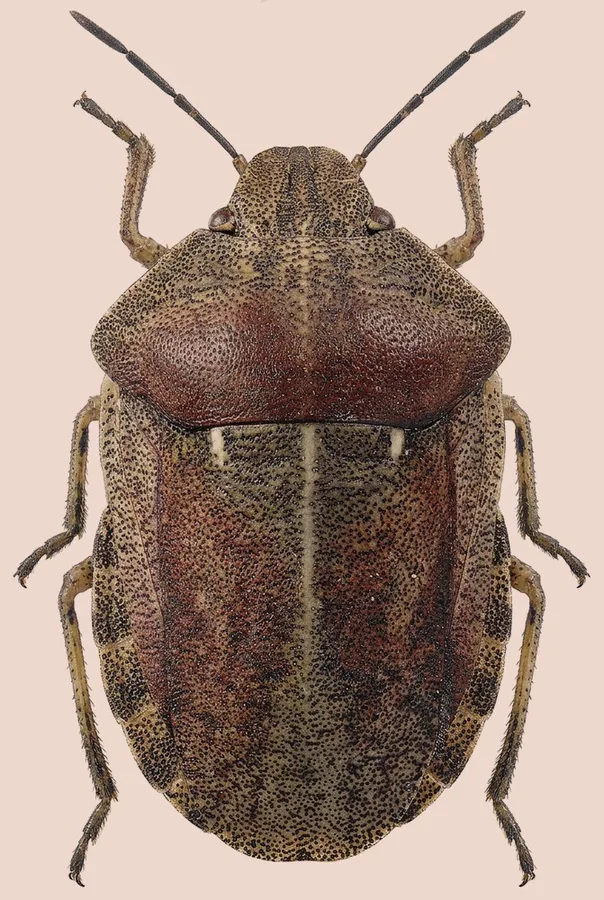
Tortoise bug
Its enlarged shield covers the whole body, and it looks so similar to a close relative that genital examination is often needed to separate the two.
| Where | Dry and damp grassland |
|---|---|
| Size | 9 to 11 mm body length |
| When | May to September |
The Tortoise bug has a broad, shell like scutellum covering its entire abdomen and wings, coloured in mixed sandy browns and greys with fine dark pitting.
Nymphs and adults feed on grasses through the growing season in both dry and damp grassland, resting low among the stems when not active.
Traits
Habitat
Grassland
Colour
Brown, Grey
Active
Day
To people
Does not bite or sting; it feeds only on grasses and is harmless to handle.
Activity through the year
Often confused with
Slightly smaller at 8 to 11 mm and more smoothly rounded at the rear, without the more angular hind corners of the Tortoise bug.
Questions
Is the Tortoise bug dangerous to people?
Does not bite or sting; it feeds only on grasses and is harmless to handle.
When can you see the Tortoise bug?
The Tortoise bug can be seen from May to September, by day.
Plate retouched from a photo by Göran Liljeberg, CC BY 3.0, Wikimedia Commons Licence
Report a mistake in this entry
True bugs›Jewel bugs›Eurygaster
Last updated 2026-09-26. Every entry is checked against published sources.