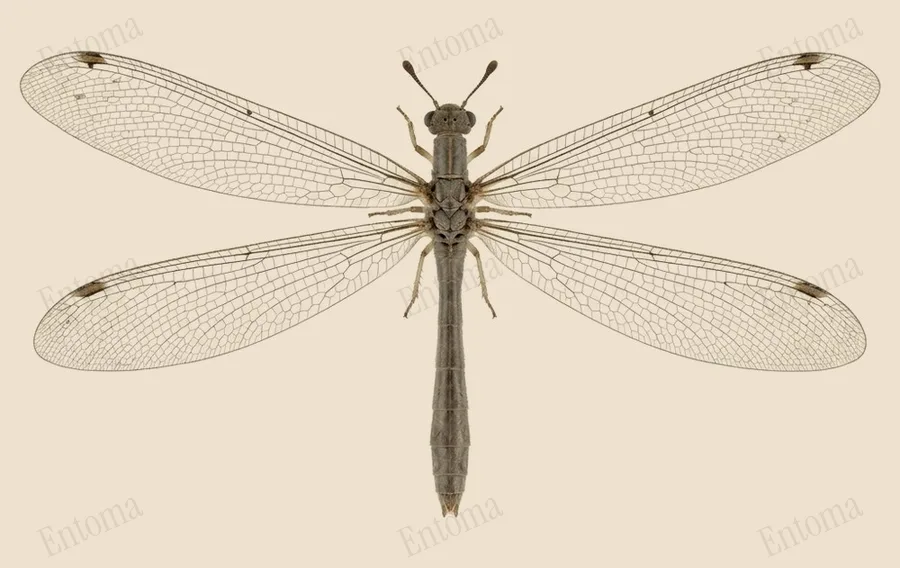
Four-spotted antlion
Unlike most antlions, its larvae hunt freely in loose soil and never dig the classic cone shaped pit trap.
| Where | Dry, sandy or rocky scrubland |
|---|---|
| Size | 65 to 75 mm wingspan |
| When | June to September |
This slender, dragonfly-like insect has two pairs of long, transparent, heavily veined wings, each marked with one dark brownish black spot, giving four spots in total, along with thickened, club-tipped antennae and a long narrow abdomen. At rest the wings are held together in a tent-like shape over the body.
Larvae live buried in dry, fine soil or in rocky crevices and stone walls rather than building pit traps, ambushing ants and other small insects from cover, while adults are most often seen fluttering weakly around vegetation or lights after dark.
Traits
Habitat
Heath
Colour
Brown, Grey
Active
Night
To people
Harmless to people; adults have no sting or bite and are rarely noticed except around lights at night.
Activity through the year
Often confused with
Similar in size with a wingspan around 70 mm, but its wings are peppered with many small brown spots rather than four bold dark marks, and its larvae dig a distinct conical pit trap in sandy soil.
Questions
Is the Four-spotted antlion dangerous to people?
Harmless to people; adults have no sting or bite and are rarely noticed except around lights at night.
When can you see the Four-spotted antlion?
The Four-spotted antlion can be seen from June to September, at night.
Plate retouched from a photo by Syrio, CC BY‑SA 4.0, Wikimedia Commons Licence
The plate on this page is shared under the same licence as its source, CC BY-SA.
Report a mistake in this entry
Last updated 2026-09-26. Every entry is checked against published sources.