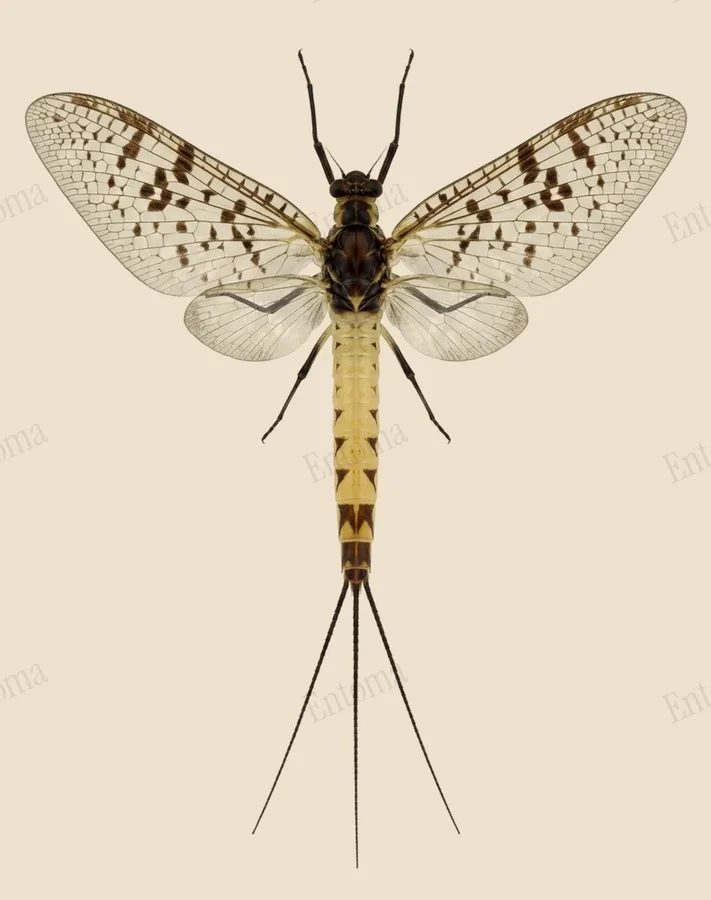
European green drake
Its nymph can spend up to two years burrowing through river gravel, yet the winged adult cannot feed and dies within days.
| Where | Rivers and lakes with gravel beds |
|---|---|
| Size | 20 to 40 mm wingspan |
| When | March to November |
This mayfly has a pale yellow to olive body with three long tail filaments, and translucent wings with dark veining that appear duller and yellowish in the short-lived subimago stage; the wings span roughly 20 to 40 mm.
Nymphs burrow into sandy or gravelly river and lake beds for one to two years before a mass spring emergence, after which the short-lived adults mate over the water and die within a day or two.
Traits
Habitat
Wetland
Colour
Yellow, Brown
Active
Day
To people
Harmless; the short-lived adults do not feed, bite, or sting.
Activity through the year
Often confused with
This close relative is duller and very slightly smaller, with bold dark triangular markings on every abdominal segment rather than mostly on the rear segments as in the green drake.
Questions
Is the European green drake dangerous to people?
Harmless; the short-lived adults do not feed, bite, or sting.
When can you see the European green drake?
The European green drake can be seen from March to November, by day.
Plate retouched from a photo by gailhampshire from Cradley, Malvern, U.K, CC BY 2.0, Wikimedia Commons Licence
Report a mistake in this entry
Mayflies›Burrowing mayflies›Ephemera
Last updated 2026-09-26. Every entry is checked against published sources.