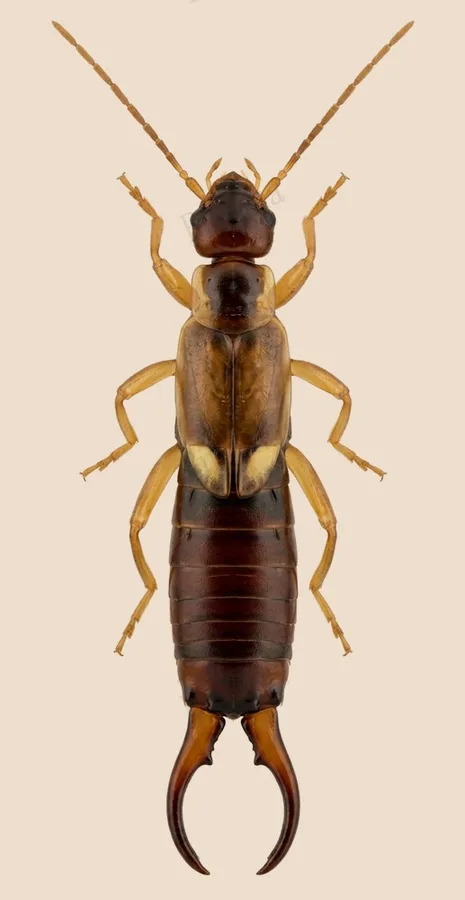
European earwig
Its curved pincers look fearsome but are mainly used in courtship and rival fights, not for pinching or biting people.
| Where | Gardens and damp crevices |
|---|---|
| Size | 12 to 15 mm body length |
| When | April to October |
The European earwig is a slender, flattened, reddish brown insect about 12 to 15 mm long, with short leathery forewings and a pair of curved pincers at the tip of the abdomen. Males have long, strongly curved pincers, often longer than the abdomen itself, while females carry shorter, nearly straight ones.
It hides by day in damp, dark crevices such as bark, leaf litter, and flowerpots, becoming active at night to feed on aphids, other small insects, fungi, and soft plant material; a female guards and cleans her eggs and young nymphs underground through the winter, an unusual level of care among insects.
Traits
Habitat
Garden
Colour
Brown
Active
Night
To people
Its pincers can deliver a mild pinch if handled roughly, but it does not bite and does not seek out human ears, despite the old superstition behind its name.
Activity through the year
Often confused with
Lesne's earwig is much smaller at about 8 mm long against 12 to 15 mm in the European earwig, and it never develops the flying hindwings that the European earwig keeps folded beneath its short forewings.
Questions
Is the European earwig dangerous to people?
Its pincers can deliver a mild pinch if handled roughly, but it does not bite and does not seek out human ears, despite the old superstition behind its name.
When can you see the European earwig?
The European earwig can be seen from April to October, at night.
Plate retouched from a photo by Syrio, CC BY‑SA 4.0, Wikimedia Commons Licence
The plate on this page is shared under the same licence as its source, CC BY-SA.
Report a mistake in this entry
Earwigs›Common earwigs›Forficula
Last updated 2026-09-26. Every entry is checked against published sources.