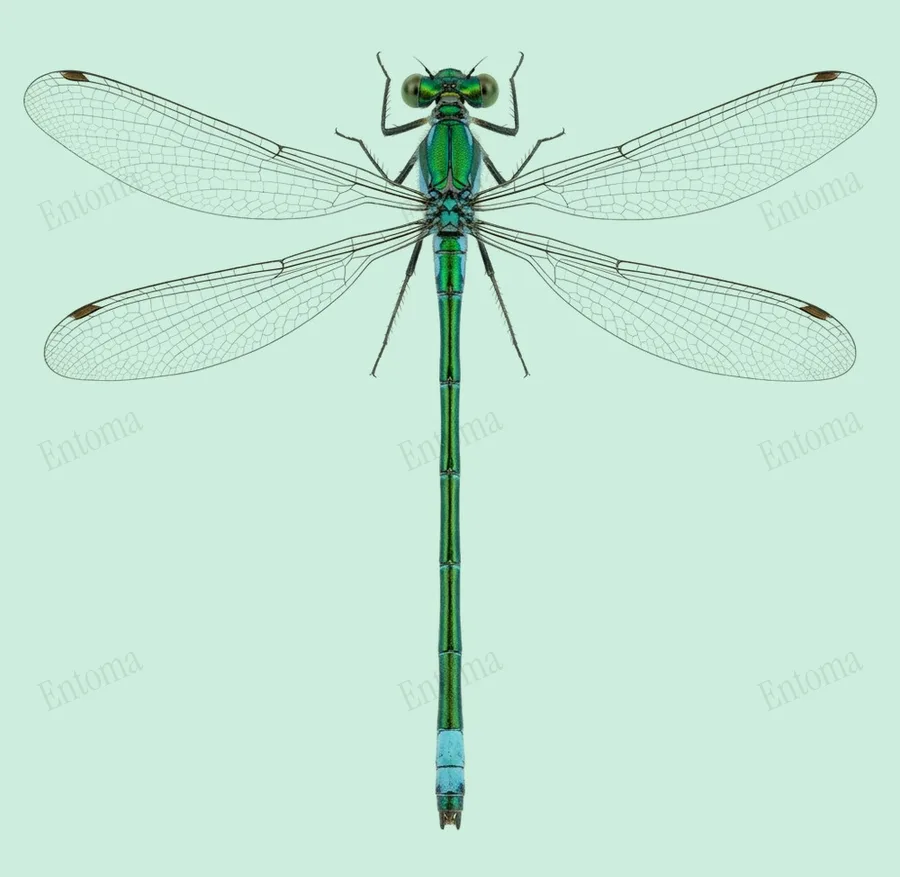
Common spreadwing
Females can stay fully submerged for up to thirty minutes while piercing waterweed stems to lay their eggs, breathing trapped air from a silvery film on their body.
| Where | Reedy ponds, lakes and ditches |
|---|---|
| Size | 33 to 38 mm body length |
| When | June to September |
The Common spreadwing is a metallic green damselfly about 33 to 38 mm long. Males have pale blue eyes and a powder-blue tip to the abdomen, while females are metallic green with pale beige stripes on the thorax. Both rest with their wings held half open rather than closed.
Pairs mate away from water for thirty to sixty minutes and then remain joined while the female lays eggs into submerged or waterline plant stems, sometimes staying underwater for long periods. It is the last damselfly to emerge each year, on the wing from June to September around ponds and lakes with plenty of reeds.
Traits
Habitat
Wetland
Colour
Green, Blue
Active
Day
To people
Harmless to people; does not sting or bite.
Activity through the year
Often confused with
Similar green colouring but slightly larger and more heavily built at 35 to 42 mm, with shorter, inward-curved anal appendages in males instead of the longer, straighter ones of the Common spreadwing.
Questions
Is the Common spreadwing dangerous to people?
Harmless to people; does not sting or bite.
When can you see the Common spreadwing?
The Common spreadwing can be seen from June to September, by day.
Plate retouched from a museum specimen photo by Estonian Museum of Natural History, CC BY 4.0, GBIF Licence
Report a mistake in this entry
Dragonflies and damselflies›Spreadwings›Lestes
Last updated 2026-09-26. Every entry is checked against published sources.