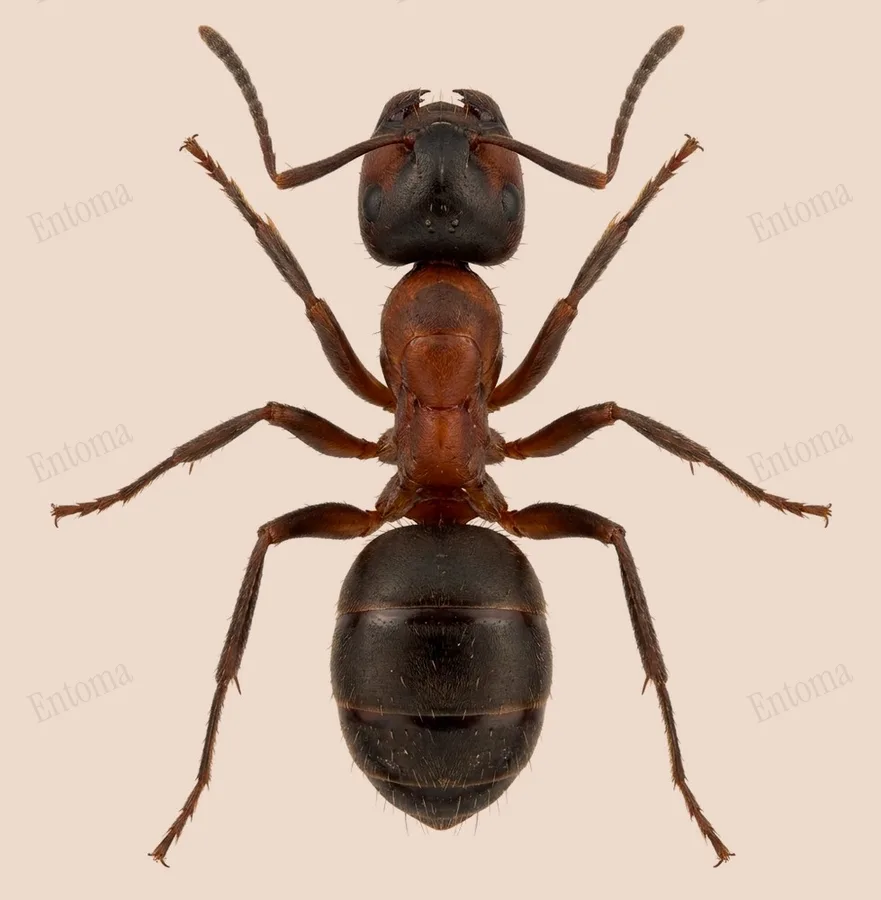
Central European bicolored ant
This ant nests inside masonry, tree bark and pavement cracks in cities, its reddish-brown thorax standing out sharply against its darker head and abdomen.
| Where | Walls, tree bark and pavements |
|---|---|
| Size | 3 to 5.5 mm body length |
| When | March to September |
This ant is easily recognized by its two-toned coloring: a reddish-brown thorax contrasting with a darker brown head and abdomen, unlike the uniformly black common black garden ant it is often confused with.
Colonies nest in dry stone walls, tree bark, pavement cracks and buildings, and workers forage actively on the surface, tending aphids on nearby plants for honeydew.
Traits
Habitat
Towns
Colour
Brown, Red
Active
Day
To people
Not aggressive toward people, though it will bite and spray irritating formic acid if its nest is disturbed.
Activity through the year
Often confused with
Very similar in size and habit, but it is uniformly black, lacking the reddish-brown thorax of the Central European bicolored ant.
Questions
Is the Central European bicolored ant dangerous to people?
Not aggressive toward people, though it will bite and spray irritating formic acid if its nest is disturbed.
When can you see the Central European bicolored ant?
The Central European bicolored ant can be seen from March to September, by day.
Plate retouched from a photo by amborella, CC BY 4.0, iNaturalist Licence
Report a mistake in this entry
Bees, wasps and ants›Ants›Lasius
Last updated 2026-09-26. Every entry is checked against published sources.