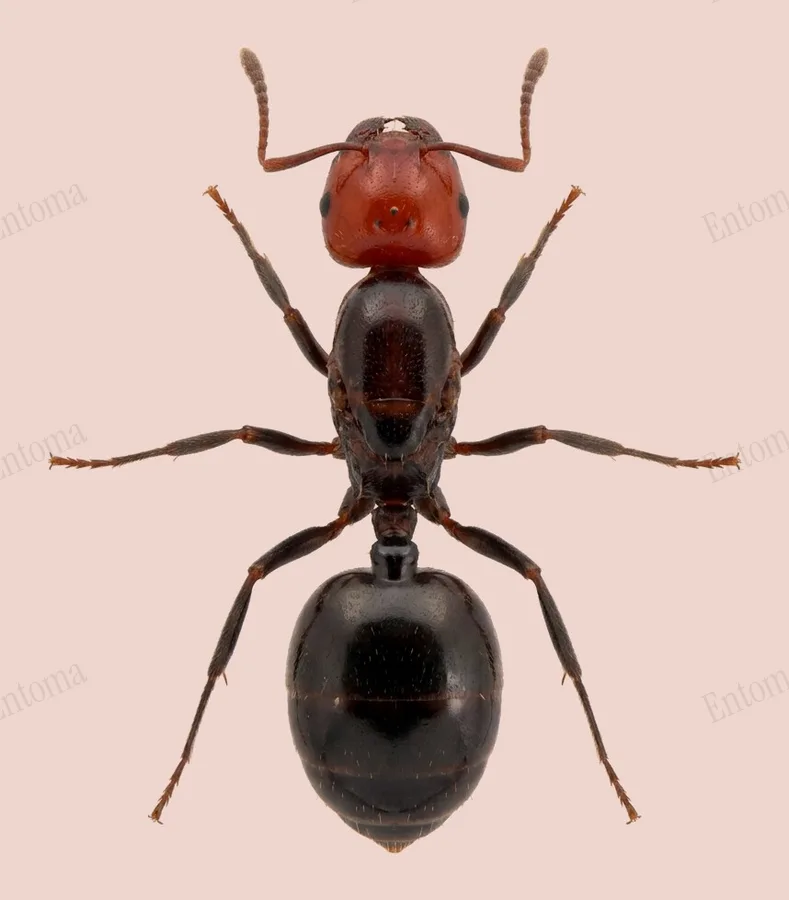
Mediterranean acrobat ant
When threatened, workers flip their heart-shaped abdomen up over their head like a scorpion's tail to dab attackers with irritating secretions.
| Where | Mediterranean woodland and stone walls |
|---|---|
| Size | 3 to 10 mm long |
| When | March to October |
This ant ranges from reddish-brown to dark brown, with a darker head and thorax than its paler, heart-shaped gaster, which workers can raise upright over the body; workers run 3 to 6 mm long, and queens 7 to 10 mm.
Colonies nest in dead wood, bark crevices, and stone walls across Mediterranean woodland and towns, defending themselves with a mild sting and sprayed secretions rather than aggressive biting.
Traits
Habitat
Woodland
Colour
Brown
Active
Day
To people
Mild
Workers can deliver a mild, painful sting in defence, though the species is not aggressive toward people.
Activity through the year
Often confused with
The black garden ant is similarly dark but has a rounded gaster it cannot flip up over its head, and it lacks a functional sting, unlike the Mediterranean acrobat ant.
Questions
Is the Mediterranean acrobat ant dangerous to people?
Mild. Workers can deliver a mild, painful sting in defence, though the species is not aggressive toward people.
When can you see the Mediterranean acrobat ant?
The Mediterranean acrobat ant can be seen from March to October, by day.
Plate retouched from a photo by Eveha, CC BY‑SA 4.0, Wikimedia Commons Licence
The plate on this page is shared under the same licence as its source, CC BY-SA.
Report a mistake in this entry
Bees, wasps and ants›Ants›Crematogaster
Last updated 2026-09-26. Every entry is checked against published sources.