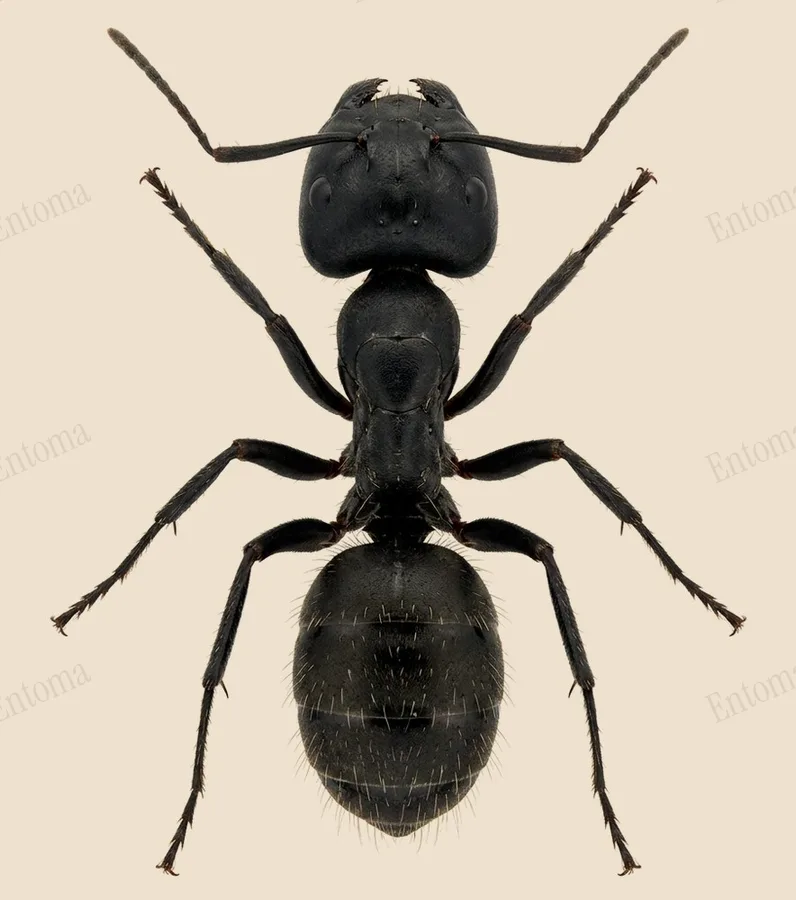
Hairy carpenter ant
Major workers spray precise jets of formic acid at rivals, a chemical weapon that stands in for the sting this ant lacks entirely.
| Where | Dry dead wood in forest |
|---|---|
| Size | 6 to 18 mm body length (workers to queens) |
| When | March to October |
The hairy carpenter ant is a large, entirely black ant covered in long, pale hairs that give it a shaggy, faintly silvery look. Workers vary greatly in size, from small minors around 6 to 9 mm long to big headed majors reaching 10 to 15 mm, with queens larger still at 14 to 18 mm.
Colonies nest inside dry dead wood such as old stumps and fallen logs in warm, sunny woodland, most often pine forest; lacking a functional sting, workers defend the nest by biting hard with their mandibles while spraying formic acid from the tip of the abdomen.
Traits
Habitat
Woodland
Colour
Black, Grey
Active
Day and night
To people
Mild
It has no sting, but its bite is strong for an ant and its formic acid spray can sting the skin briefly, so nests are best left undisturbed rather than handled.
Activity through the year
Often confused with
The red-and-black carpenter ant overlaps in size but its queens run larger at 16 to 18 mm against 14 to 18 mm in the hairy carpenter ant, and its reddish thorax immediately separates it from the all-black hairy carpenter ant.
Questions
Is the Hairy carpenter ant dangerous to people?
Mild. It has no sting, but its bite is strong for an ant and its formic acid spray can sting the skin briefly, so nests are best left undisturbed rather than handled.
When can you see the Hairy carpenter ant?
The Hairy carpenter ant can be seen from March to October, by day and at night.
Plate retouched from a photo by Syrio, CC BY‑SA 4.0, Wikimedia Commons Licence
The plate on this page is shared under the same licence as its source, CC BY-SA.
Report a mistake in this entry
Bees, wasps and ants›Ants›Camponotus
Last updated 2026-09-26. Every entry is checked against published sources.