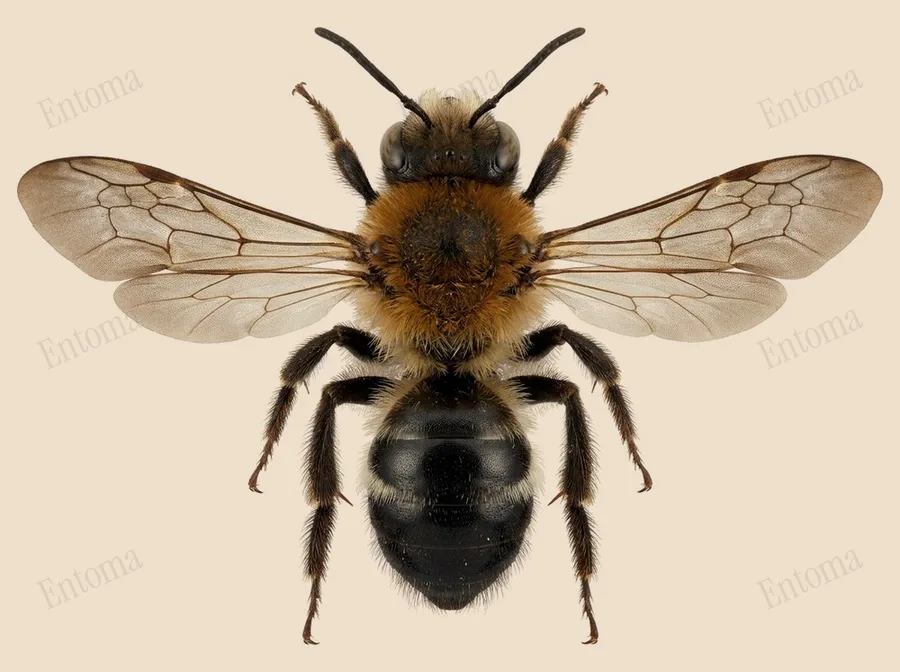
Grey-patched mining bee
Male mining bees of this species carry copious white hair over the face, while females instead show white patches only on the sides of the abdomen.
| Where | Grassland, lawns and pastures |
|---|---|
| Size | 8 to 13 mm body length |
| When | March to June |
This mining bee is larger than a honeybee, with the female showing bright foxy brown hair on the thorax, a polished black abdomen, and white hair patches on the sides of the first three abdominal segments. Males are slimmer with a paler thorax and copious white facial hair.
Females dig nest burrows alone in bare or short turf, including lawns and sheep grazed pasture, rather than forming large colonies. Adults are active from spring into early summer, feeding at a range of flowering plants.
Traits
Habitat
Grassland
Colour
Brown, Black, White
Active
Day
To people
Mild
Docile and easily approached while foraging or digging; females carry a weak sting and rarely use it unless handled.
Activity through the year
Often confused with
Close in size at about 10 to 14 mm, but with a uniformly dark brown abdomen lacking the pale side patches of the Grey-patched mining bee, and two toned hairs on the hind leg.
Questions
Is the Grey-patched mining bee dangerous to people?
Mild. Docile and easily approached while foraging or digging; females carry a weak sting and rarely use it unless handled.
When can you see the Grey-patched mining bee?
The Grey-patched mining bee can be seen from March to June, by day.
Plate retouched from a museum specimen photo by Valkeila, Finnish Museum of Natural History - Zoology Unit, CC BY 4.0, GBIF Licence
Report a mistake in this entry
Bees, wasps and ants›Mining bees›Andrena
Last updated 2026-09-26. Every entry is checked against published sources.