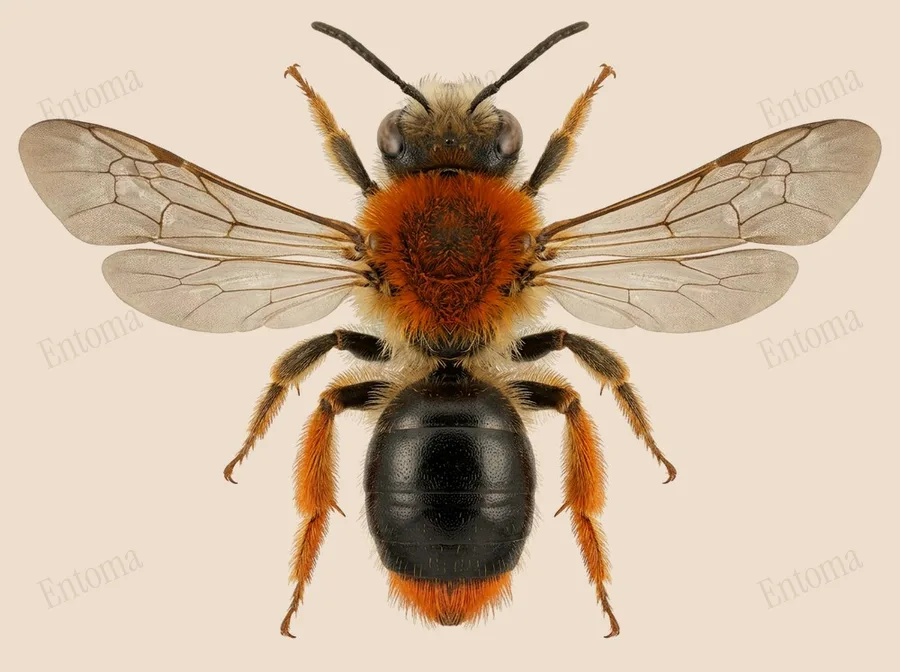
Early mining bee
This solitary bee excavates its own nest burrow in bare soil each spring, yet dozens of females sometimes dig side by side without forming a shared colony.
| Where | Gardens, parks, banks and path edges |
|---|---|
| Size | 8 to 11 mm body length |
| When | March to June |
Females have a neat covering of rich red hairs across the thorax and a sparse black abdomen tipped with a small tuft of red hair, while males are slighter with browner, less vivid hairs. Both sexes have orange hind legs, and males show a dark patch in the middle of the hind tibia.
This is one of the earliest mining bees to emerge each spring, and females dig nesting burrows in light, bare soil on sunny banks and path edges, sometimes in loose aggregations of many nests though each female works her own burrow alone. Adults visit willow, blackthorn and dandelion flowers for pollen and nectar.
Traits
Habitat
Garden
Colour
Orange, Brown
Active
Day
To people
Mild
A quiet, non aggressive bee; females carry a weak sting and use it only if squeezed or handled.
Activity through the year
Often confused with
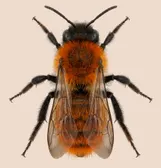
Similar size at about 8 to 12 mm body length, but females are covered head to tail in dense, uniform fox red hair rather than the two toned red thorax and black abdomen of the Early mining bee.
Questions
Is the Early mining bee dangerous to people?
Mild. A quiet, non aggressive bee; females carry a weak sting and use it only if squeezed or handled.
When can you see the Early mining bee?
The Early mining bee can be seen from March to June, by day.
Plate retouched from a museum specimen photo by Villu Soon, University of Tartu, Natural History Museum and Botanical Garden, CC BY 4.0, GBIF Licence
Report a mistake in this entry
Bees, wasps and ants›Mining bees›Andrena
Last updated 2026-09-26. Every entry is checked against published sources.