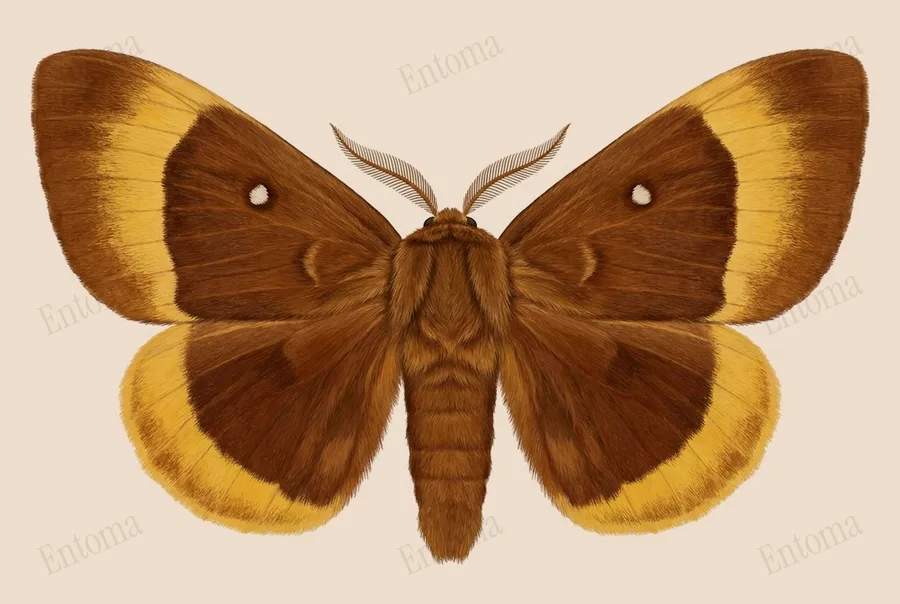
Oak eggar
Despite its name, the caterpillar is not known to feed on oak; the moth is instead named for its acorn-shaped, egg-like cocoon.
| Where | Heathland, moorland and hedgerows |
|---|---|
| Size | 45 to 75 mm wingspan |
| When | May to August |
Males are red-brown with a pale yellow band across the forewing and fly fast in sunshine, while females are larger, paler and buff-colored, flying mainly at night; wingspan ranges from about 45 to 75 mm.
Caterpillars feed mainly on heather and bilberry, also taking bramble and hawthorn, and can take one or two years to develop depending on the region.
Traits
Habitat
Heath
Colour
Brown, Yellow
Active
Day and night
To people
Harmless
Activity through the year
Often confused with
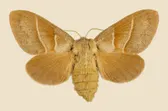
The fox moth is similar in size, with a wingspan of about 40 to 65 mm against the oak eggar's 45 to 75 mm, but both sexes show two straight pale cross-lines on the forewing that the oak eggar lacks.
Questions
Is the Oak eggar dangerous to people?
The Oak eggar is harmless to people.
When can you see the Oak eggar?
The Oak eggar can be seen from May to August, by day and at night.
Plate retouched from a photo by Didier Descouens, CC BY‑SA 4.0, Wikimedia Commons Licence
The plate on this page is shared under the same licence as its source, CC BY-SA.
Report a mistake in this entry
Butterflies and moths›Lappet moths›Lasiocampa
Last updated 2026-09-26. Every entry is checked against published sources.